
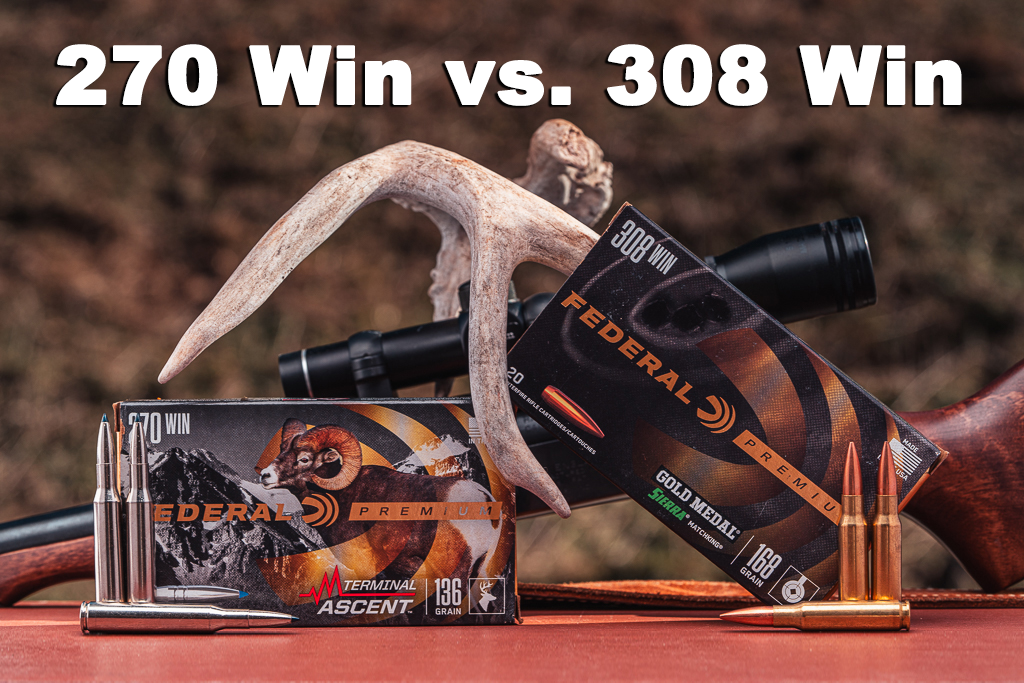
Whether you are a lifelong deer hunter or breaking into a new outdoor hobby, selecting a cartridge can be tough. Two of the most popular hunting options are the .270 Winchester and the .308 Winchester.
Either of these rounds can deliver excellent performance. They are used for whitetail, pronghorn, and mule deer, and, under certain situations, can even be used to harvest a thick black bear.
While their purposes are similar, there are clear differences in these two rounds. Understanding these differences will help you make the best choice…
270 Win vs 308 Win: Summary
| .270 Winchester | .308 Winchester | |
|---|---|---|
| Bullet Diameter | .277 inches | .308 inches |
| Neck Diameter | .308 inches | .3433 inches |
| Base Diameter | .470 inches | .4728 inches |
| Case Length | 2.54 inches | 2.015 inches |
| Overall Length | 3.34 inches | 2.8 inches |
| Case Capacity | 67 grains | 56 grains |
| Max pressure (SAAMI) | 65,000 psi | 62,000 psi |
| Bullet Weights | 90 - 150 grains | 125 - 185 grains |
| Typical Firearm | Bolt-action rifles | Semiautomatic and bolt-action rifles |
Bullet Size
One of the obvious differences is bullet size. As you likely know (or guessed), the .308 Winchester bullet is wider than the .270’s. Because the bullet is wider, it also has heavier bullets. There is a fair amount of overlap, but the .308 ranges from about 125 grains to 185 grains, while the .270’s range is roughly 90 to 150. Most of the .270 rounds pack about 130- to 150-grain bullets, while .308 bullets hover around 150 to 170 grains.
Case Size
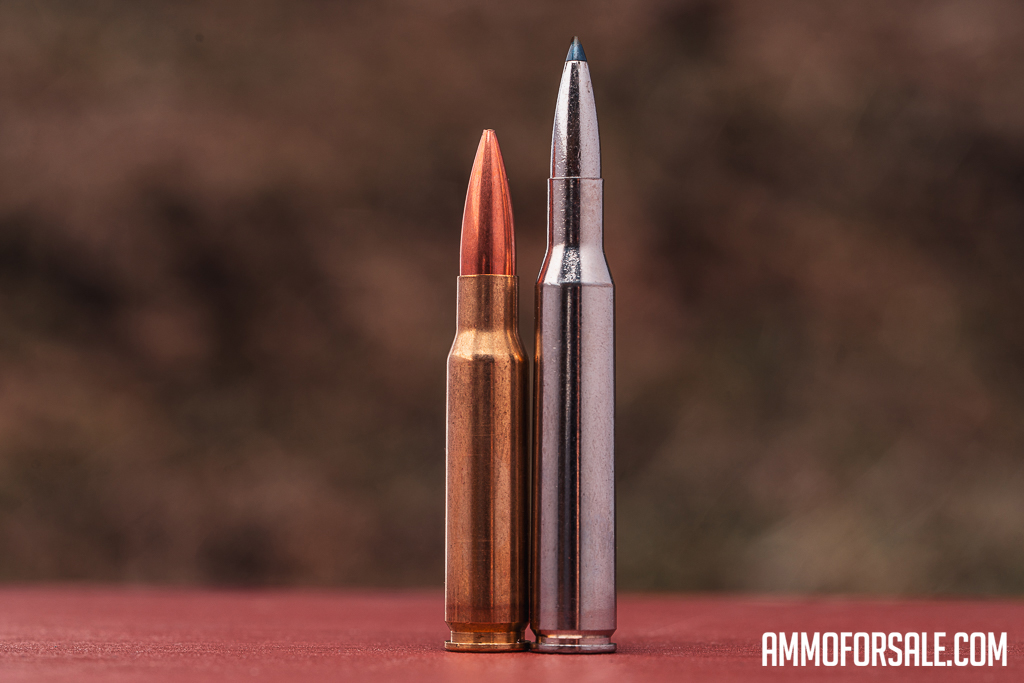
While the .308 packs heavier bullets, the .270 Winchester has a larger case. Case width is similar, but the .270’s case is nearly half an inch longer. This results in a case capacity of 67 grains compared to the .308’s case capacity of 56 grains.
Internal Pressure
Internal pressure, which is directly connected to the amount of force with which the bullet is ejected, is higher in the .270 Winchester. This, perhaps more than any other factor, impacts the cartridges’ performance.
Market Conditions
If you are purchasing a rifle, it helps to know that you can find quality ammunition. After all, what’s the point in owning a rifle if you can’t find ammo to load? Market conditions matter to shooters, and while the .270 is not a rare or novelty item, the market for the .308 is more versatile and expansive.
Simple numbers tell the story. When this article was written, we had 33 options in-stock for .270 ammo, a count that includes various package sizes of the same product. Simultaneously, there were 84 choices for .308 Winchester / 7.62x51mm ammunition.
And the .308 has more variety, especially for target shooting and competition, which are virtually impossible to find for the .270. In other words, owners can find hunting and target loads for the .308; only hunting loads for the .270.
Performance
Velocity Comparison
| Ammo Name | Muzzle Velocity | 200-Yard Velocity | 400-Yard Velocity |
|---|---|---|---|
| 270 Win - Remington 100 Gr. Core-Lokt | 3,320 | 2,559 | 1,913 |
| 270 Win - Winchester 130 Gr. Deer Season | 3,060 | 2,642 | 2,261 |
| 270 Win - Barnes 130 Gr. VOR-TX | 3,140 | 2,655 | 2,219 |
| 270 Win - Hornady 140 Gr. Interlock SP | 2,940 | 2,563 | 2,216 |
| 270 Win - Federal 150 Gr. Nosler Partition | 2,830 | 2,446 | 2,093 |
| Average of 270 Win | 3,058 | 2,573 | 2,140 |
| 308 Win - Hornady 125 Gr. Custom Lite | 2,675 | 2,121 | 1,641 |
| 308 Win - Hornady 150 Gr. Interlock SP | 2,820 | 2,316 | 1,868 |
| 308 Win - Winchester 150 Gr. Deer Season | 2,820 | 2,368 | 1,960 |
| 308 Win - Barnes 168 Gr. VOR-TX | 2,700 | 2,330 | 1,989 |
| 308 Win - Remington 180 Gr. Core-Lokt | 2,620 | 1,955 | 1,415 |
| Average of 308 Win | 2,727 | 2,218 | 1,775 |
With more propellant behind a lighter bullet, it’s no surprise that the .270 Winchester is a faster load. It’s worth noting that the .308 Winchester stats were dragged down by the 125-grain Custom Lite from Hornady, which is intentionally weakened to give an easier recoil.
The slowest .270 Winchester, however, is still faster than the fastest .308 Winchester.
Which Cartridge Delivers More Energy?
| Ammo Name | Muzzle Energy | 200-Yard Energy | 400-Yard Energy |
|---|---|---|---|
| 270 Win - Remington 100 Gr. Core-Lokt | 2,447 | 1,454 | 813 |
| 270 Win - Winchester 130 Gr. Deer Season | 2,702 | 2,015 | 1,475 |
| 270 Win - Barnes 130 Gr. VOR-TX | 2,847 | 2,036 | 1,422 |
| 270 Win - Hornady 140 Gr. Interlock SP | 2,687 | 2,042 | 1,526 |
| 270 Win - Federal 150 Gr. Nosler Partition | 2,667 | 1,992 | 1,459 |
| Average of 270 Win | 2,670 | 1,908 | 1,339 |
| 308 Win - Hornady 125 Gr. Custom Lite | 1,986 | 1,248 | 748 |
| 308 Win - Hornady 150 Gr. Interlock SP | 2,649 | 1,787 | 1,162 |
| 308 Win - Winchester 150 Gr. Deer Season | 2,648 | 1,787 | 1,162 |
| 308 Win - Barnes 168 Gr. VOR-TX | 2,720 | 2,025 | 1,477 |
| 308 Win - Remington 180 Gr. Core-Lokt | 2,743 | 1,528 | 800 |
| Average of 308 Win | 2,549 | 1,691 | 1,093 |
Energy stats are closer, but overall the .270, despite having lighter bullets (which often translates to lower energies), is a bit more powerful. With a larger case, the .270 can give higher energy from the muzzle to the target, although there is plenty of overlap.
The most powerful in this small sample was the 130-grain .270 Winchester VOR-TX from Barnes. Second-most powerful was the 168-grain .308 VOR-TX. Both the .308 and .270 have multiple rounds in the 2,600 to 2,750 ft-lbs range, so hunters likely won’t choose one or the other based on energy, although it seems the .270 is better at maintaining downrange energy.
Which Shoots Flatter?
| Ammo Name | Drop at 100 Yards (inches) | 200 Yards (inches) | 400-Yard (inches) |
|---|---|---|---|
| 270 Win - Remington 100 Gr. Core-Lokt | 1.3 | 0 | -6.6 |
| 270 Win - Winchester 130 Gr. Deer Season | 1.4 | 0 | -6.4 |
| 270 Win - Barnes 130 Gr. VOR-TX | 1.3 | 0 | -6.3 |
| 270 Win - Hornady 140 Gr. Interlock SP | 1.6 | 0 | -6.8 |
| 270 Win - Federal 150 Gr. Nosler Partition | 1.7 | 0 | -7.6 |
| 308 Win - Hornady 125 Gr. Custom Lite | 2.3 | 0 | -10.1 |
| 308 Win - Hornady 150 Gr. Interlock SP | 1.9 | 0 | -8.4 |
| 308 Win - Winchester 150 Gr. Deer Season | 1.9 | 0 | -8.1 |
| 308 Win - Barnes 168 Gr. VOR-TX | 2 | 0 | -8.4 |
| 308 Win - Remington 180 Gr. Core-Lokt | 2.6 | 0 | -11.9 |
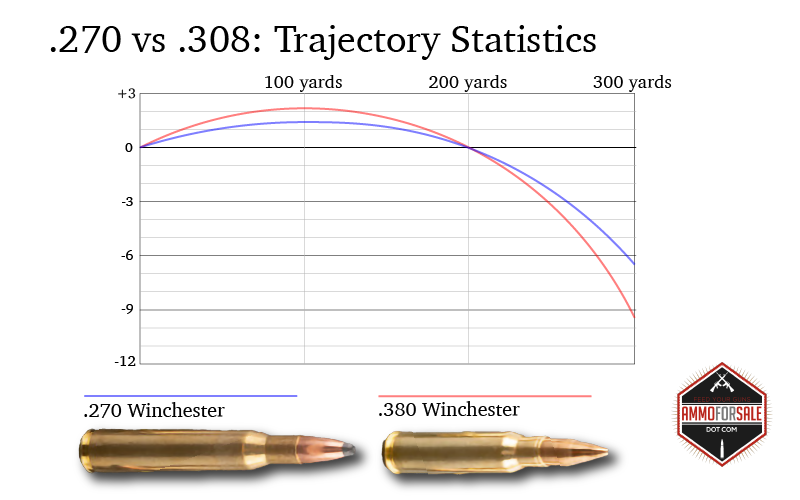
While shooter skill is most important, straight trajectory matters. The statistics are similar again, but overall the .270 has a slightly straighter trajectory. When zeroed to 200 yards, the most it drops at 300 is 7.6 inches, while the .308 has drops approaching 12 inches.
Why Select the .308 Winchester over the .270?
We just went through three factors, all were beneficial to the .270. So why select the .308? For starters, it’s a more consumer-friendly round. The .308 Winchester is available in a wide variety of options for the range and field; the same can’t be said about the .270.
Also, the .308 is likely better for large game, especially at medium range. Although energies for the .270 Winchester are higher, the larger wound channel and heavier bullet can result in significant damage. Many elk, bear, and large game hunters prefer the .308 Winchester.
There’s also the AR factor. The .308 Winchester is available in AR-10 semiautomatic rifles, making it a versatile option that range shooters love. The .270 is only available in bolt-action rifles, a fun and effective but slower and less versatile package.
Why Select the .270 Winchester over the .308?
But if you want more long-range accuracy, and you don’t plan on hunting moose or elk, the .270 Winchester is a great choice. In virtually any terrain, especially open spaces with long distances, the .270 Winchester will often outperform the .308.
Leave A Comment