
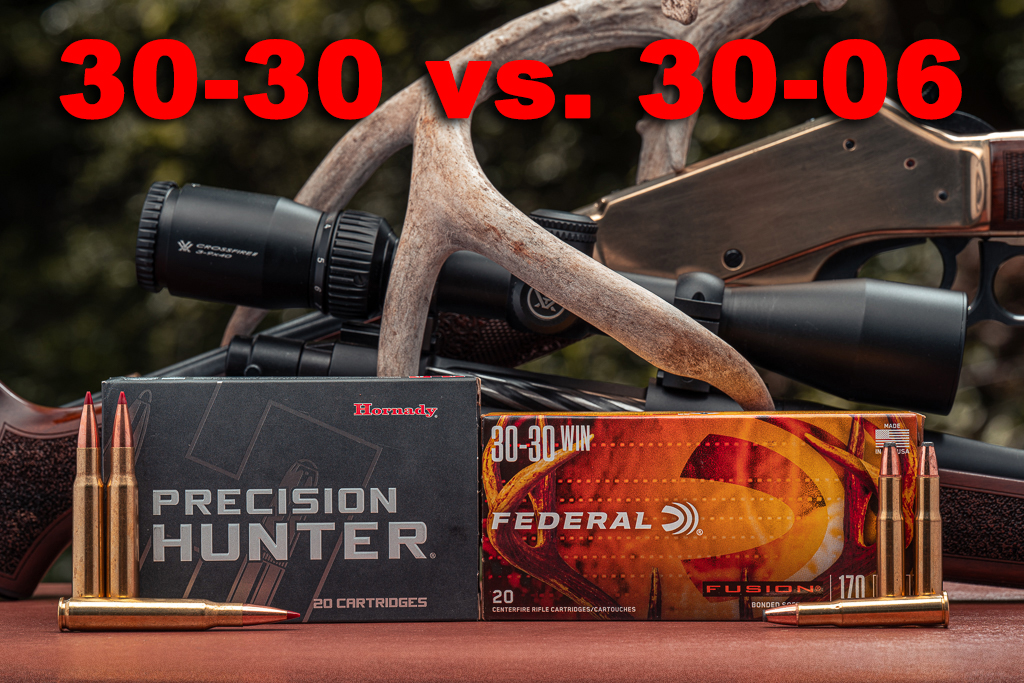
WOAH! Are we implying that the 30-30 Winchester and 30-06 Springfield are very similar rifle cartridges, with differences so subtle as to require extensive analysis to be understood properly?
No.
“This is an apples-to-oranges comparison.” That’s the most common critique of articles like this one. It’s common because it’s correct. Still, when you see calibers with “30” at the start, it’s fair to go down the path of a comparison.
Quick Answer: What’s the Difference Between 30-30 and 30-06?
30-06 is much larger than the 30-30 and packs a lot more energy downrange than the 30-30 does. The 30-06 is faster and flies with less drop than the 30-30 over the same distance. That said, 30-06’s recoil is far stronger than the 30-30.
Both are great options for hunting most game in North America but the 30-06 is what you’ll opt for if you’re going after larger game, like elk.
Their Histories
The 30-30 Win was introduced in 1895 as the first “small bore” (i.e. .32 caliber or narrower) sporting rifle cartridge designed for smokeless powder (i.e. modern propellant). It was (and still is) only intended for hunting medium game at ranges out to 200 yards. (Beyond that range, the 30-30’s characteristically “drooping” trajectory makes precision shooting increasingly difficult.)
The 30-06 Spring was introduced in 1906 to the U.S. Army, which, at the time, was wholly disinterested in whitetail, hogs, and black bear. What the Army really wanted was a combat cartridge that neutralizes enemy combatants at ranges out to 1,000 yards.
They got it. The 30-06 would serve as our military’s primary combat cartridge for almost half of a century, and remained in use long after its replacement by the 7.62x51mm and 5.56x45mm in 1957.
Though not a hunting cartridge by design, the 30-06 (A) indisputably kills medium (and large) game deader than disco, and (B) won over millions of fans during both World Wars, the Korean War, and to a lesser extent Vietnam. Turns out veterans prefer hunting with the same ammo they were extensively trained to fire. Go figure!
All of that is to say that the “apples-to-oranges” nitpick isn’t wrong. But that’s not the point of this article. It’s to help newer shooters understand how the two rounds’ performance compares to one another, that they may make an informed choice regarding which is preferable for their needs.
If you’re debating whether to go with the 30-30 or 30-06 this hunting season, keep reading.
30-30 vs. 30-06: Physical Dimensions
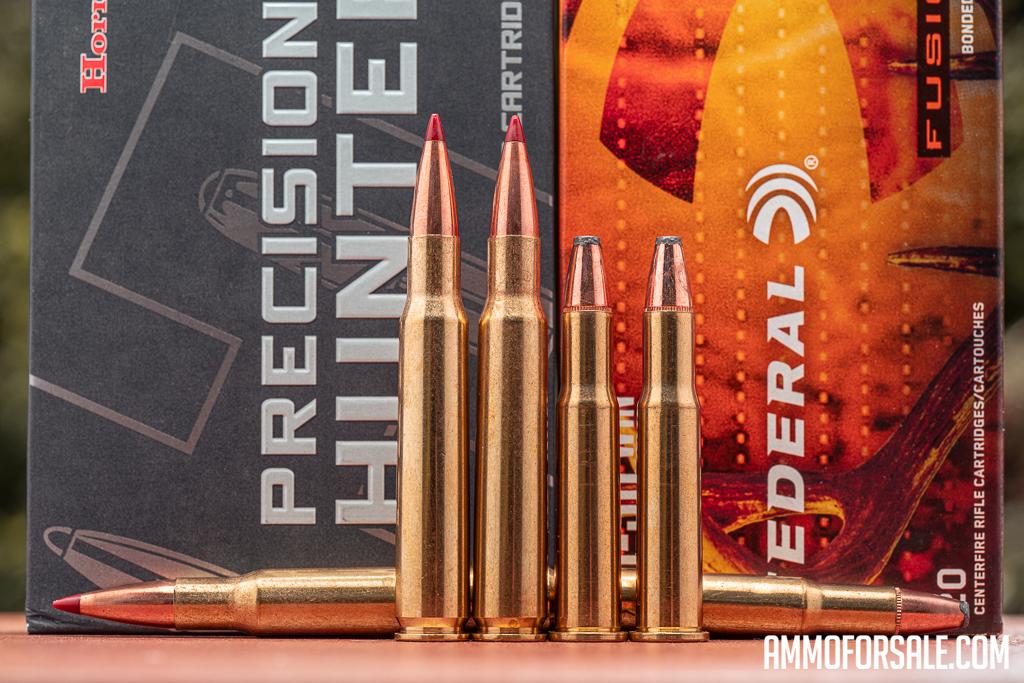
30-06 ammo (left) next to 30-30 cartridges (right)
You can tell a lot about these two rounds by placing them side by side. The 30-06? It’s bigger, which you would be extremely correct to interpret as evidence of it being more powerful.
Though not substantially wider, the 30-06’s case is 0.445” longer than the 30-30’s. The 30-06 case is 50% more capacious as a result, which means it can store more propellant (i.e. the stuff that explodes to propel the bullet).
It doesn’t necessarily seat more bullet, though. The 30-30 and 30-06 share the same bullet diameter, and are often loaded with bullets of identical weight as well. In other words, the 30-06 can put a lot more energy into the exact same projectile, which is the textbook definition of “being more powerful.”
| 30-30 | 30-06 | |
|---|---|---|
| Parent case | 38-55 | 30-03 |
| Bullet diameter | .308" | .308" |
| Land diameter | .300" | .300" |
| Neck diameter | .330" | .3404" |
| Shoulder diameter | .401" | .4425" |
| Base diameter | .422" | .4708" |
| Rim diameter | .506" | .474" |
| Case length | 2.039" | 2.494" |
| Overall length | 2.550" | 3.340" |
| Case capacity | 45.2 gr H2O | 68.0 gr H2O |
| Max pressure (SAAMI) | 42,000 psi | 60,000 psi |
Rimmed For Your Pleasure
The other key difference between these two rounds is their rims. The 30-30’s rim sticks out 0.084” from its base. The 30-06’s rim, on the other hand, is nonexistent. It is rimless.
This has huge implications for the types of rifles the rounds are designed for. The 30-30’s rim is optimal for a lever action. Although bolt-action and single-shot alternatives do exist, the vast majority of 30-30 rifles are lever guns.
It’s worth noting that lever-action rifles have never been favored for combat. It’s awkward to rapidly operate such a rifle while you’re firing prone – an untenable handicap while people are trying to kill you.
The rimless 30-06 is less picky about rifle design. The M1903 Springfield rifle is a bolt action. Its successor, the M1 Garand, is a semi-automatic. Lever-action, single-shot, and even AR-style rifles are also chambered for 30-06.
To summarize, the 30-30 is the weaker cartridge, and one that requires the use of a lever-action loading mechanism (or no loading mechanism at all). The 30-06 is the more powerful round, and gives you a wider range of options vis-à-vis rifle design.
30-30 vs. 30-06: Ballistics
Naturally, when two cartridges are loaded with the same bullet – and one cartridge accelerates its bullet to a higher velocity – we should expect it to deliver the flatter trajectory as well. Our following comparisons illustrate just how much flatter the 30-06’s bullets fly relative to the 30-30’s.
Velocity & Energy
| Range (yds) | Velocity (fps) | Energy (ft lbs) | Elevation (in) | Range (yds) | Velocity (fps) | Energy (ft lbs) | Elevation (in) |
| 0 | 2390 | 1903 | -1.5 | 0 | 2900 | 2802 | -1.5 |
| 100 | 2086 | 1449 | 3.3 | 100 | 2674 | 2383 | 1.7 |
| 200 | 1806 | 1086 | 0 | 200 | 2460 | 2016 | 0 |
| 300 | 1554 | 804 | -14 | 300 | 2256 | 1695 | -7.4 |
| 400 | 1337 | 596 | -42.5 | 400 | 2061 | 1415 | -21.8 |
| 500 | 1166 | 453 | -90.6 | 500 | 1876 | 1173 | -44.3 |
| Range (yds) | Velocity (fps) | Energy (ft lbs) | Elevation (in) | Range (yds) | Velocity (fps) | Energy (ft lbs) | Elevation (in) |
| 0 | 2200 | 1827 | -1.5 | 0 | 2789 | 2937 | -1.5 |
| 100 | 1895 | 1355 | 4.2 | 100 | 2590 | 2532 | 1.9 |
| 200 | 1620 | 990 | 0 | 200 | 2399 | 2173 | 0 |
| 300 | 1381 | 720 | -17.5 | 300 | 2217 | 1855 | -7.9 |
| 400 | 1191 | 535 | -53.4 | 400 | 2042 | 1574 | -22.9 |
| 500 | 1060 | 424 | -113.8 | 500 | 1876 | 1329 | -46.3 |
| Range (yds) | Velocity (fps) | Energy (ft lbs) | Elevation (in) | Range (yds) | Velocity (fps) | Energy (ft lbs) | Elevation (in) |
| 0 | 2040 | 1756 | -1.5 | 0 | 2750 | 3191 | -1.5 |
| 100 | 1789 | 1350 | 4.7 | 100 | 2599 | 2850 | 1.8 |
| 200 | 1561 | 1028 | 0 | 200 | 2453 | 2539 | 0 |
| 300 | 1362 | 783 | -19.1 | 300 | 2312 | 2255 | -7.6 |
| 400 | 1199 | 607 | -57 | 400 | 2175 | 1996 | -21.7 |
| 500 | 1081 | 493 | -119.1 | 500 | 2043 | 1761 | -43.2 |
When we compare two rounds with identical bullet weights, the 30-06’s ballistic superiority becomes obvious. The faster a bullet flies, the less time gravity has to pull it downward between points A and B. The effect, as you can see in our comparisons, is that the 30-06 doesn’t have to rise as high above the bore line en route to its target, and also drops off less severely after passing zero.
Accuracy
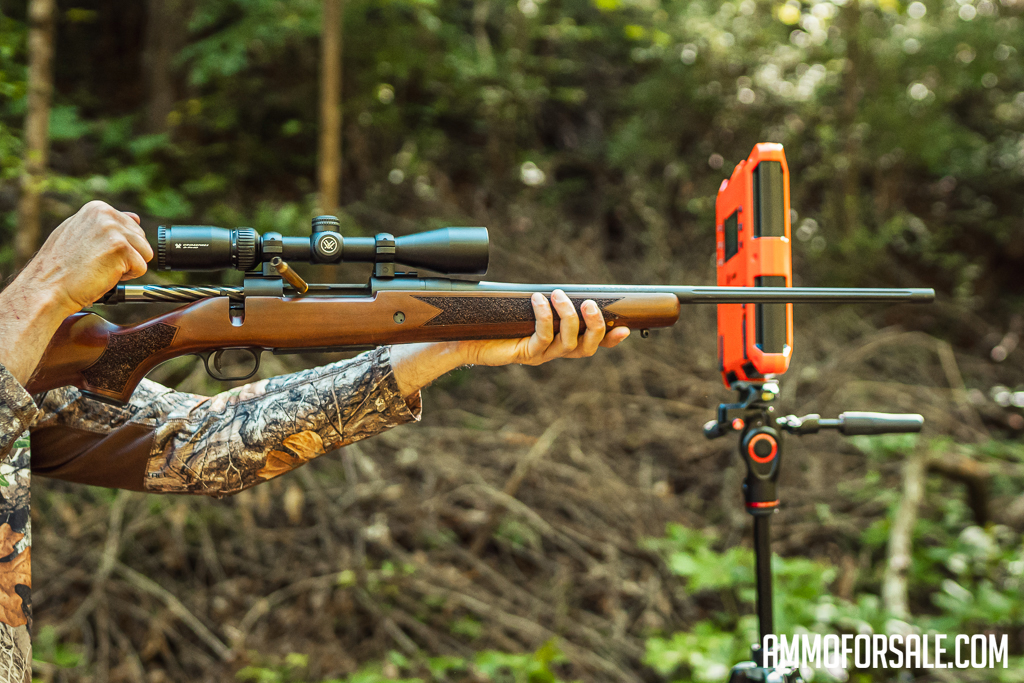
No single factor determines a round’s “accuracy.” The most significant one, which is the shooter’s marksmanship, is unquantifiable. That being said, the 30-06’s flatter trajectory is more forgiving of ranging errors, and generally facilitates accuracy over greater distances. That also being said, the 30-30 can be laser-accurate within the 150 to 200 yards it is designed to cover. Any accuracy advantage the 30-06 can be argued to offer only manifests itself beyond the 30-30’s effective range.
It must be noted that its lower velocity isn’t the 30-30’s only ballistical disadvantage. Because the cartridge is designed for lever-action rifles, its bullet’s tip must be flat. (If it were pointed, i.e. “spitzer,” then it could strike and ignite whichever primer it butts up against inside a tubular magazine, which is undesirable for obvious reasons.) The 30-30 bullet’s flat nose isn’t nearly as aerodynamically efficient as the 30-06 bullet’s pointed one, which causes it to (A) generate more drag, (B) lose velocity at a faster rate, and (C) shed more energy and momentum as it races downrange.
(Note: Hornady LEVERevolution ammo features pointed, polymer-tipped bullets that are safe for insertion in tubular magazines. Such bullets can easily increase the 30-30’s effective range on whitetail to 250 yards, although that still pales in comparison to the 30-06’s 300- to 400-yard effective range on the same.)
30-30 vs. 30-06: Stopping Power
Like “accuracy,” “stopping power” is a contentious term. It can’t be objectively defined, because too much depends on shot placement, which is not an intrinsic property of the cartridge. For example, a weak bullet that hits its target has undeniably greater stopping power than a powerful one that misses.
All other things being equal, the bullet that strikes its target harder has more stopping power. (Bullet diameter is also important, as a wider bullet generally damages more flesh. We’ll ignore that for now, since these two rounds share identical bullet diameter.) Refer to the charts above and you’ll see that the 30-06, which ejects the same bullet with more force, has higher muzzle energy (i.e. the amount of kinetic energy the bullet possesses the instant it exits the barrel).
The 30-06 maintains its stopping power advantage at every point downrange as well. For illustration, consider this graph which shows the ranges at which our comparison rounds deliver at least 1,500 ft lbs (the minimum usually recommended for elk) and 1,000 ft lbs (ditto, but for whitetail) of energy.
| Maximum Range at Which Bullet Conserves at Least X ft lbs Kinetic Energy (yds) |
||
|---|---|---|
| 1,500 ft lbs | 1,000 ft lbs | |
| 30-30 150gr Bonded SP | 87 | 323 |
| 30-30 170gr Partition | 67 | 197 |
| 30-30 190gr FN FB | 60 | 210 |
| 30-06 150gr Bonded SP | 368 | 582 |
| 30-06 170gr Polymer Tip | 429 | 662 |
| 30-06 190gr AccuBond LR | 624 | 927 |
To reiterate, the 30-06 nearly always strikes its target harder than the 30-30, and it delivers heaps more energy to its target at any given distance as well. If all you care about is power, then that’s the only reason you need to favor the 30-06 over the 30-30.
30-30 vs. 30-06: Recoil
We have so far shown the 30-06’s chief advantages: its flatter trajectory, longer effective range, and greater stopping power. If you suspect those advantages come at the cost of stronger recoil, then you’re really smart.
Let’s calculate our comparison rounds’ free recoil energy to get a sense of how hard they kick in relation to each other. That measure of recoil is the product of only four variables: rifle weight, propellant charge weight, bullet weight, and muzzle velocity. In the interest of keeping things equal, let’s assume we’re firing two 7.5 pound rifles. For the sake of simplicity, let’s assume all 30-30 cartridges are loaded with 30 grains of propellant, and all 30-06 are loaded with 50 (noting that heavier bullets typically require heavier propellant charges).
| Recoil Energy (ft lbs) | |
|---|---|
| 30-30 150gr Bonded SP | 10.9 |
| 30-30 170gr Partition | 11.6 |
| 30-30 190gr FN FB | 12.2 |
| 30-06 150gr Bonded SP | 19.8 |
| 30-06 170gr Polymer Tip | 22.2 |
| 30-06 190gr AccuBond LR | 25.2 |
It’s important to note that rifle weight bears significantly on recoil. A lighter one will kick harder; a heavier one, lighter. You should also note that the amount of recoil you actually perceive is subjective, and therefore immeasurable.
But even when we acknowledge those caveats (and the imperfection of our calculations), the 30-06 can easily generate twice as much recoil as the 30-30. That’s of real importance if you’re trying to train and hunt more comfortably, or minimize the amount of muzzle flip you have to contend with while lining up follow-up shots.
30-30 vs. 30-06: Availability and Cost
These are popular hunting cartridges. Both are manufactured by numerous companies, loaded with a variety of bullets, and readily available for purchase from brick-and-mortar and online retailers.
It’s usually easier to find FMJ ammo (i.e. the cheapest choice for target shooting) in 30-06, however. And despite being larger and requiring more raw materials for its production, the 30-06’s incomparably greater popularity (which allows manufacturers to leverage the economy of scale) makes it slightly cheaper as well. For those reasons alone, the 30-06 generally goes a bit easier on the wallet than 30-30 ammo might be.
Conclusion
Are you hunting in the woods, or on other terrain where game isn’t visible at ranges beyond 200 yards? Do you want to put venison on the table using a classic, low-recoiling lever-action rifle? Then, you’ll easily realize why the 30-30 has stayed popular for over 130 years.
Are you hunting where long-range shots are possible? Do you possess the marksmanship requisite for landing such shots, and not mind a healthy dose of recoil each time you squeeze the trigger? Then you’ll have little difficulty appreciating why the 30-06 has remained one of America’s absolute favorite hunting cartridges for so long.
Leave A Comment