
In the very first episode of The Simpsons, Bart (aka “The Boy”) mischievously gets a tattoo. His mother, horrified, spends the family’s entire remaining Christmas fund on laser tattoo removal. During the ride home, Bart’s sister Lisa (aka “The Worst Character in the Show”) repeatedly pokes his tattoo injury. Bart says in response:
“Ow! Quit it. Ow! Quit it. Ow! Quit it.”
This scene reminds me of many shooters’ reactions to firing a 308 Winchester rifle for the first time.
Many rifle cartridges kick harder than the 308 Win. Compared to the 338 Lapua Magnum or 375 H&H Magnum, the 308 Win’s recoil is like a head butt from an elderly Pomeranian. The 308 Win just so happens to be one of America’s favorite hunting rounds, which is why it introduces a great many shooters to the world of “big” rifle cartridges.
If you’re only accustomed to firing spooty little intermediate combat cartridges like the 5.56×45 or 7.62×39 – or so new to shooting that you haven’t even cut your teeth on the 22 LR – then you’re likely to find the 308 Win’s recoil quite daunting.
And that’s why we’re about to recommend some great low-recoil ammo. But first, let’s explain what recoil is, and how you can reduce it regardless of which ammo you’re firing.
What Is Recoil?
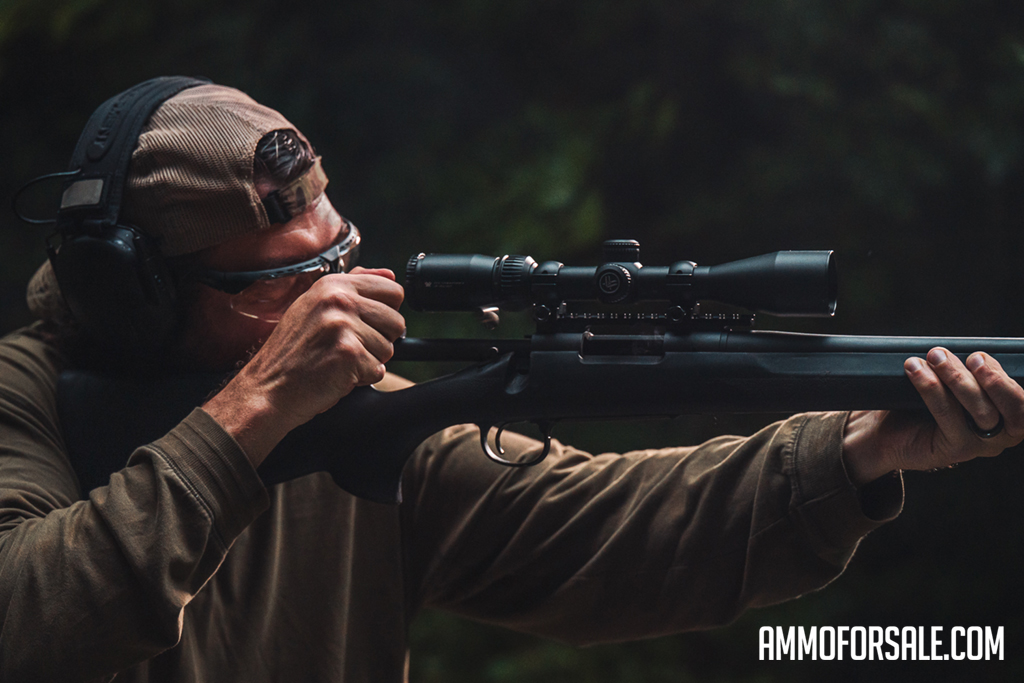
“For every action there is an equal and opposite reaction.” I learned that by watching Mr. Peabody & Sherman. It accounts for why you feel recoil when you fire a gun, during which the bullet exiting the muzzle is the action, and recoil – i.e. backward movement of force – is the opposite reaction.
“Recoil” can refer to different things. To most shooters, it’s immeasurable; a purely subjective assessment of how hard a firearm kicks, and how much discomfort (if any) it inflicts on ignition. Also immeasurable is how recoil feels. For example, the abrupt, snappy kick of 40 S&W starkly contrasts to the 45 ACP’s slower, pushier recoil.
Recoil can also be measured by objective means. For example, “Free recoil” is the product of exactly four variables: firearm weight, bullet weight, propellant (i.e. powder) weight, and muzzle velocity (i.e. how fast the bullet exits the barrel). Increase firearm weight, and reduce recoil as a result. Raise any of the remaining variables, and recoil increases instead.
I won’t teach you the equation for calculating free recoil. It is complicated and I am stupid. Fortunately, you can use this handy tool to calculate free recoil for any cartridge, which I will do for each recommendation to come.
How Much Recoil Is Too Much?
Ultimately, the answer to that question is subjective. An acceptable amount of recoil to one shooter may be impalatable to the next. To demonstrate, hand a 250-pound construction worker and a 95-pound vegan “influencer” the same 308 Win rifles and instruct them to fire. Guess which one is more likely to report excessive recoil?
Mathematics provides a more satisfactorily exact answer. According to the Text Book of Small Arms (1909), 15 foot-pounds (ft lbs) of free recoil energy is the maximum permissible for a military rifle. Any higher, and the shooter is likely to experience a “gun-headache” (which is admittedly not the greatest pain a gun could theoretically inflict to one’s head, but still unpleasant).
To summarize the two answers to the question: (A) it depends on what you find to be uncomfortable, or (B) free recoil energy in excess of 15 ft lbs.
How Can You Reduce Recoil Without Changing Ammo?
Recall the four variables that determine free recoil energy. The first is firearm weight – which, when increased, reduces recoil.
You don’t necessarily have to go out and buy a new rifle if you want lighter recoil. You can instead outfit your existing rifle with a heavier stock, or add weights to its existing stock. You may also install a heavier barrel. Swapping a sporter barrel for a heavier bull variety will reduce recoil and improve accuracy (at the expense of making the rifle unwieldier, of course).
Want to go even further? Outfit your rifle with a muzzle brake, which redirects escaping high-pressure propellant gasses sideways and/or upward. This counters the backward and upward force of recoil, thereby increasing comfort and reducing muzzle rise.
Here’s something else you can add to a rifle to reduce recoil: a recoil pad, such as one made by Hogue or Pachmayr. The soft, rubbery pad affixes to the end of the butt stock. It doesn’t technically reduce free recoil, although it softens the blow to the shoulder a good deal nonetheless.
Finally, there’s skill. This may come as no surprise, but there is a correct way to handle a rifle. Learn it, and you’ll soon discover how much fatigue and discomfort you can avoid just by firing from the right stance.
Best Low Recoil 308 Ammo Options
RIGHT! Without further ado, let’s proceed to some of your best options vis-à-vis low-recoil 308 Win ammo. (Note: while calculating the following free recoil energy figures, I assumed (A) an 8-pound rifle, and (B) that each cartridge is loaded with 40 grains of propellant.)
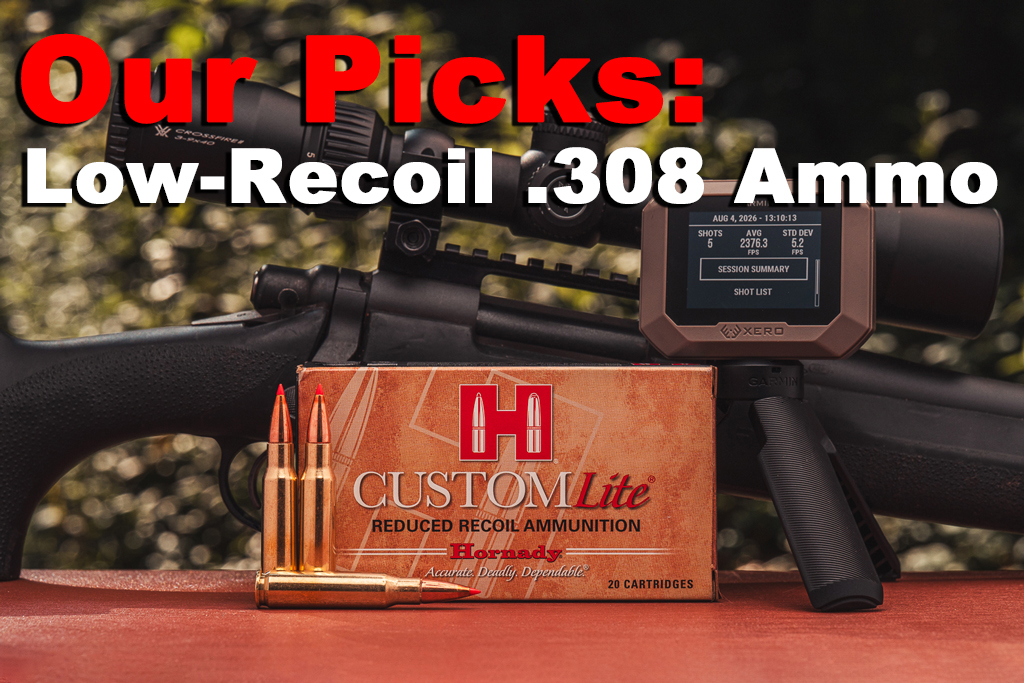
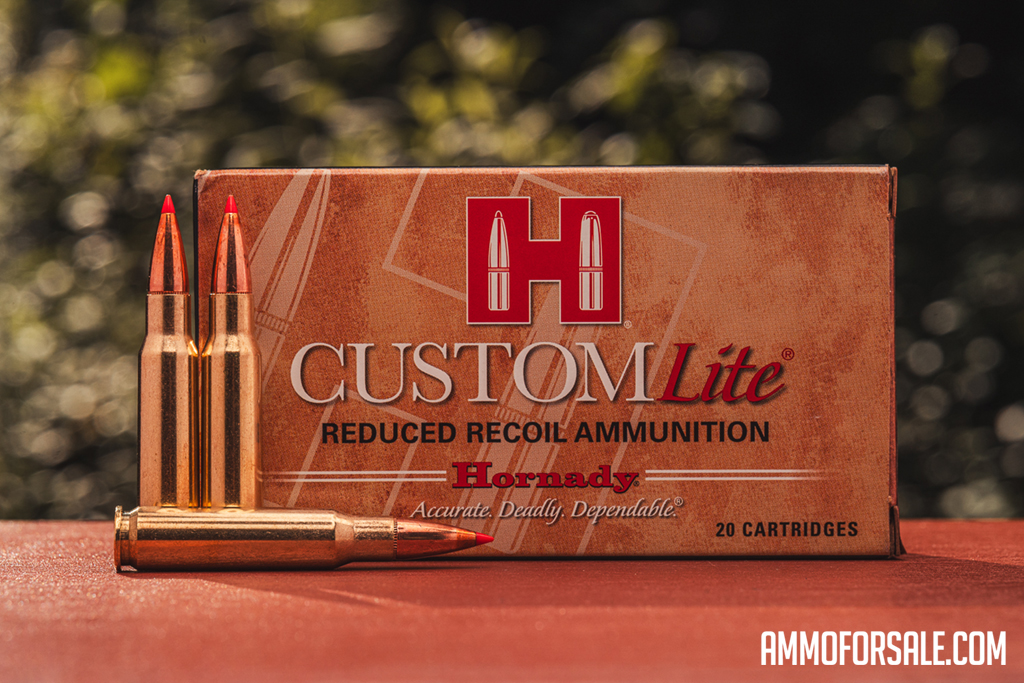
1. Hornady Custom Lite 308 Win 125 Grain SST
- Product no. 80866
- Muzzle velocity: 2,765 fps
- Muzzle energy: 2,122 ft lbs
- Free recoil: 11.8 ft lbs
Like every low-recoil recommendation in this article, this cartridge (A) is loaded with a light bullet, and (B) has a low muzzle velocity relative to its bullet’s weight. The (estimated) 11.8 ft lbs recoil is indeed low compared to more powerful loads such as Sellier & Bellot 168 grain HPBT (16.3 ft lbs), Hornady Precision Hunter 178 grain ELD-X (17.4 ft lbs), and Winchester Power Max Bonded 180 grain PHP (17.9 ft lbs).
We found it to be a fine cartridge. Granted, a low-recoil load’s gentler kick comes at the cost of reduced striking power and shorter effective range, although the Super Shock Tip (SST) bullet is streamlined to promote superior velocity retention, and also designed to exhibit the rapid terminal expansion which inflicts a deadly blow on medium game.
| Range (yds) | Velocity (fps) | Energy (ft lbs) | Elevation (in) |
| 0 | 2675 | 1986 | -1.5 |
| 100 | 2389 | 1584 | 2.3 |
| 200 | 2120 | 1248 | 0 |
| 300 | 1870 | 971 | -10.1 |
| 400 | 1641 | 748 | -30.2 |
| 500 | 1437 | 573 | -63.2 |
2. Barnes VOR-TX Reduced Recoil 110 Grain TTSX BT
- Product no. RR30801
- Muzzle velocity: 2,910 fps
- Muzzle energy: 2,068 ft lbs
- Free recoil: 11.3 ft lbs
Here we see yet another example of a cartridge with a light bullet and a relatively low muzzle velocity. Like the Hornady Custom Lite load, it too is loaded with a hunting bullet: the Tipped Triple-Shock X boat tail (TTSX BT), which is equal parts accurate and lethal.
The TTSX BT is unique among bullets featured by our recommended cartridges because it is made entirely out of copper (with the exception of its aerodynamically efficient polymer tip). Certain states require hunters to forego lead bullets in favor of monolithic alternatives, such as the TTSX BT, TSX, CX, Controlled Chaos, Trophy Copper, or Core-Lokt copper. In addition to legal compliance, these bullets offer clean performance, excellent accuracy, and reliably deep penetration (thanks to copper’s higher ductility relative to that of lead).
| Range (yds) | Velocity (fps) | Energy (ft lbs) | Elevation (in) |
| 0 | 2910 | 2069 | -1.5 |
| 100 | 2604 | 1656 | 1.8 |
| 200 | 2318 | 1312 | 0 |
| 300 | 2050 | 1027 | -8.3 |
| 400 | 1801 | 793 | -25 |
| 500 | 1576 | 606 | -52.4 |
3. Winchester Defender 308 Win 120 Grain Split Core HP
- Product no. S308PDB
- Muzzle velocity: 2,850 fps
- Muzzle energy: 2,164 ft lbs
- Free recoil: 11.7 ft lbs
Heavy recoil is the natural enemy of fast, accurate follow-up shots. It causes sharper muzzle rise, which in turn lengthens the amount of time the shooter must spend restoring their aim on target. Furthermore, strong recoil can cause the shooter to involuntarily jerk while they are squeezing the trigger – a phenomenon aptly known as “recoil flinch.”
That’s why Winchester loads their Defender series ammo, which is intended for the very application its name indicates, to produce low recoil. This round makes the 308 Win’s already potent striking power even more effective by combining it with a bullet specifically designed to neutralize human threats. It’s also loaded with low flash propellant, which can spare you from temporary blindness while you’re firing at night.
Is 308 Win the best choice of ammo for home defense? In most situations, no. Even a low-recoil load’s kick can be difficult to manage during a high-stress scenario, and the 308 Win poses a substantially higher risk of over-penetration (which can jeopardize innocent bystanders). A lighter, wieldier AR-15 chambered for 5.56×45, 300 AAC Blackout, or even 458 SOCOM would prove much more manageable, as well as powerful enough to quickly neutralize even the most determined threat.
| Range (yds) | Velocity (fps) | Energy (ft lbs) | Elevation (in) |
| 0 | 2850 | 2165 | -1.5 |
| 100 | 2509 | 1678 | 2 |
| 200 | 2194 | 1282 | 0 |
| 300 | 1901 | 964 | -9.3 |
| 400 | 1636 | 714 | -28.3 |
| 500 | 1404 | 526 | -60.4 |
4. Prvi Partizan 308 Win 123 Grain FMJ
- Product no. A-460
- Muzzle velocity: 3,035 fps
- Muzzle energy: 2,516 ft lbs
- Free recoil: 13.0 ft lbs
Hunting and home defense cartridges are normally manufactured according to higher standards for quality than target loads. They are also outfitted with more technologically advanced projectiles – i.e. ones that are designed for superior accuracy, deep penetration, and terminal expansion.
That’s what makes Prvi Partizan’s Serian-made 123 grain full metal jacket (FMJ) cartridge so great. It’s loaded with the simplest type of bullet a semi-automatic centerfire rifle can reliably chamber, albeit a steel-free one that is welcome at gun ranges which prohibit “magnetic ammo.” And because Prvi Partizan has fully earned their global reputation for great quality, you can trust these target punchers to do right by you on range day.
The Takeaway
Want to reduce recoil while you’re firing your 308 Win rifle? You can start by making your rifle heavier, outfitting it with a recoil pad or muzzle brake, or honing your shooting technique. Alternatively, you can select low-recoil ammunition. When it is loaded with a lighter projectile (i.e. 147 grains or less) and has a low muzzle velocity relative to its bullet weight, a 308 Win cartridge can’t help but generate less recoil.

Leave A Comment