
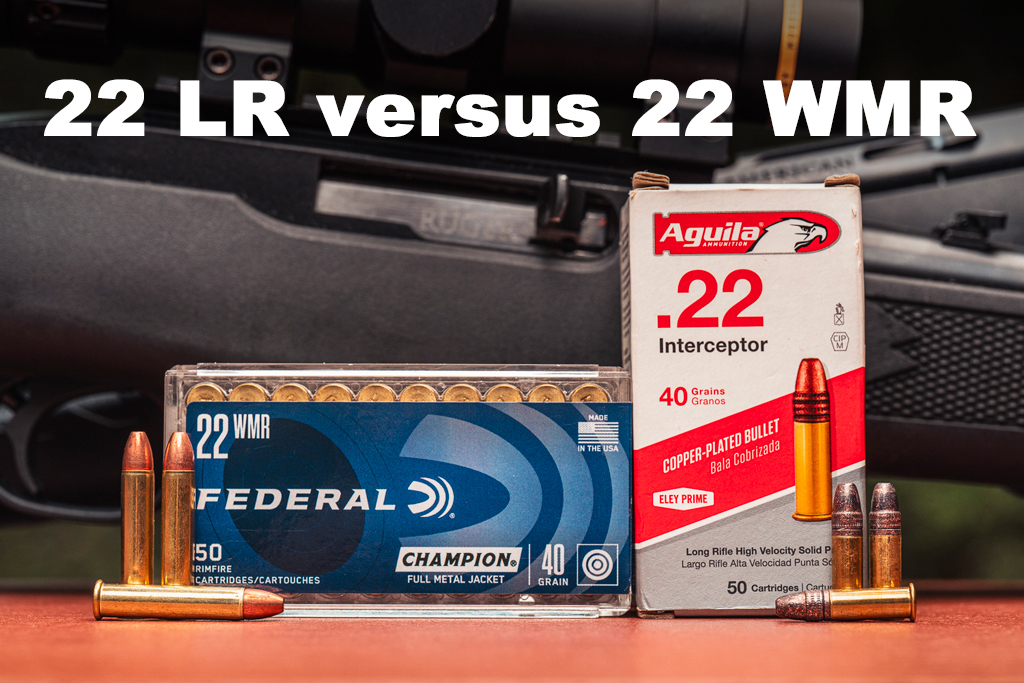
When it comes to accuracy and power, the 22 Winchester Magnum Rimfire has the 22 Long Rifle squarely beat. Does this make the 22 LR inferior to the 22 WMR (aka 22 Magnum)? Not at all. The 22 LR is beloved by all because it is an inexpensive little cartridge that excels at what it’s designed for: cheap plinking, target shooting and varmint hunting.
If you’re familiar with firearms, then you already know what it means when the word “Magnum” is in a cartridge’s name. And the 22 WMR does live up to that reputation – at least, that is to say, it honors the Magnum name as well as a rimfire round can.<p>Comparing the 22 WMR’s ballistic performance to that of the 22 LR lets you appreciate just how more power it really delivers. So let’s take a look!
Fast Answers: 22 LR vs 22 WMR
Bullet Size: Same Size Bullet
Faster Caliber: 22 WMR
More Powerful: 22 WMR
Cheaper to Shot: 22 LR
Cartridge Dimensions
| 22 LR | 22 WMR | |
|---|---|---|
| Parent case | 22 Long | 22 WRF |
| Case type | Rimmed, straight | Rimmed, straight |
| Bullet diameter | 0.223 in | 0.224 in |
| Neck diameter | 0.226 in | 0.242 in |
| Base diameter | 0.226 in | 0.242 in |
| Rim diameter | 0.278 in | 0.294 in |
| Case length | 0.613 in | 1.055 in |
| Overall length | 1.000 in | 1.350 in |
| Maximum pressure | 24,000 psi | 24,000 psi |
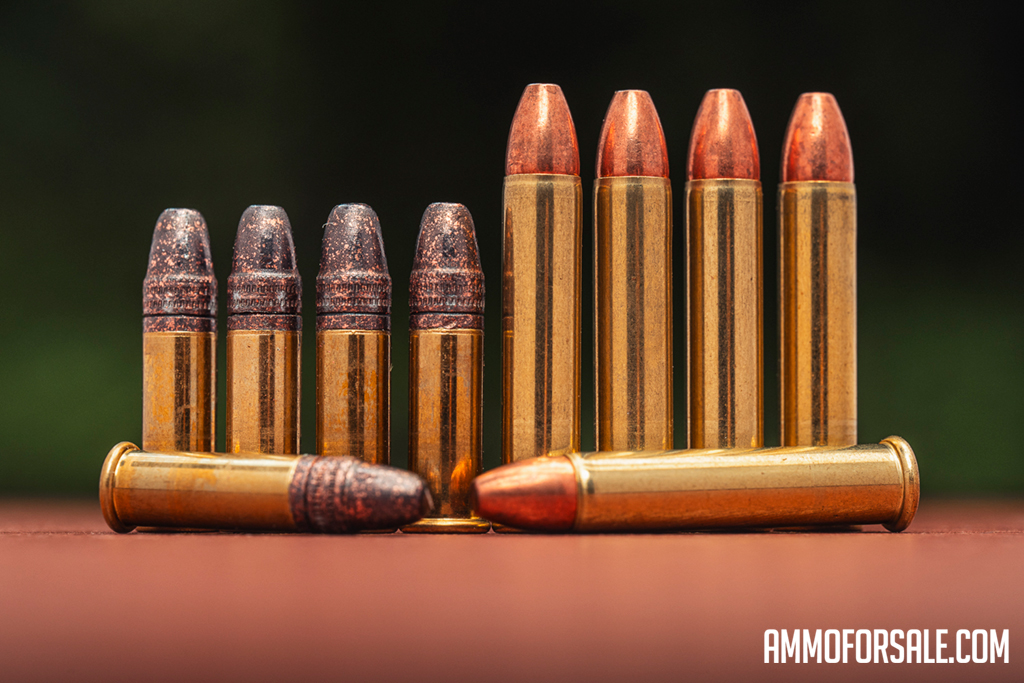
It’s easy to see what most distinguishes the 22 WMR from the 22 LR. Its case is 35% longer, which indicates that it was originally designed to store more powder. (The 22 WMR doesn’t necessarily need a greater amount of powder than the 22 LR to achieve a higher muzzle velocity these days, as powder technology has advanced a lot since the 22 WMR’s introduction in 1959.)
These cartridges can seat virtually identical projectiles. The 22 LR and the 22 WMR are usually loaded with 40 grain bullets, though lighter and heavier bullets are both common. The 22 WMR is only more powerful because it makes its bullet go faster.
Note that these are both rimfire-primed cartridges. A rimfire primer is cheaper to manufacture than the alternative Boxer primer. It is ignited when the firing pin strikes the rim of the case. The case brass must be thin enough for a firing pin to be able to dent, however, which is why rimfire-primed ammunition is weaker than virtually all Boxer-primed ammo.
Ballistic Performance
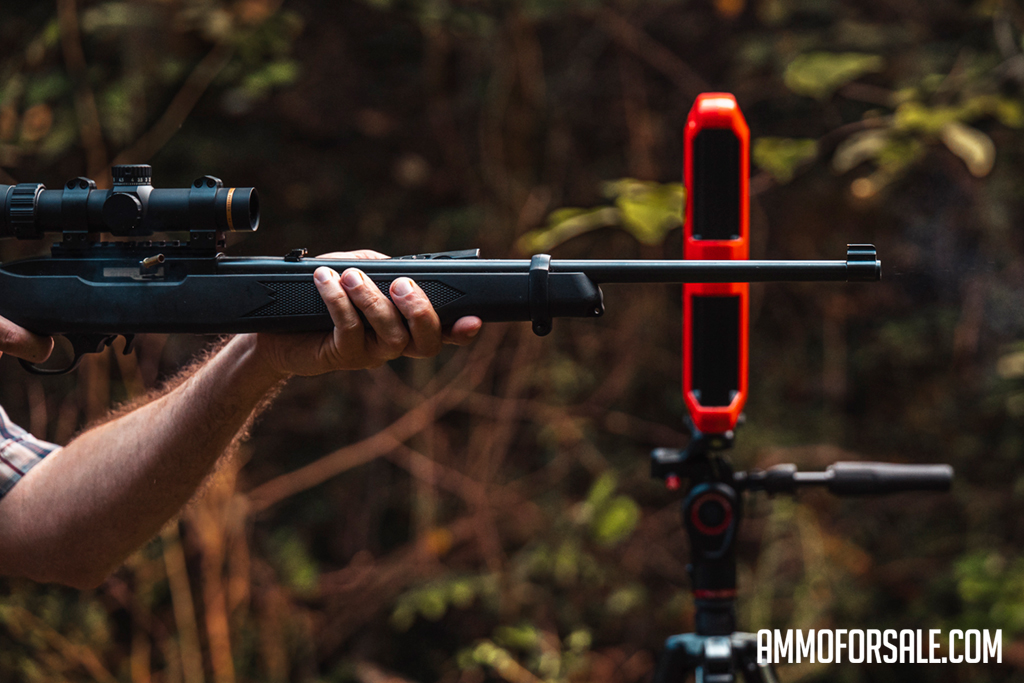
To get a good sense of how these two rounds’ ballistic performance stacks up, we selected cartridges by the same manufacturers and with identical (or at least very similar) bullet weights. To be sure, our data do not reflect everything these two rounds are capable of doing, but the overall snapshot is fairly informative.
Velocity
| 22 LR - CCI Stinger 32gr CPHP | 22 WMR - CCI Gamepoint 35gr JSP | 22 LR CCI Mini-Mag 40gr LRN | 22 WMR CCI Maxi-Mag 40gr TMJ | |
|---|---|---|---|---|
| Muzzle velocity (fps) | 1640 | 2100 | 1235 | 1875 |
| Velocity @ 25 yds | 1454 | 1956 | 1157 | 1736 |
| Velocity @ 50 yds | 1294 | 1820 | 1094 | 1605 |
| Velocity @ 75 yds | 1164 | 1690 | 1043 | 1484 |
| Velocity @ 100 yds | 1068 | 1568 | 1001 | 1372 |
| Velocity @ 125 yds | 999 | 1455 | 965 | 1272 |
| Velocity @ 150 yds | 944 | 1350 | 933 | 1186 |
| Velocity @ 175 yds | 899 | 1257 | 905 | 1116 |
| Velocity @ 200yds | 860 | 1177 | 879 | 1059 |
Our data show the 22 WMR’s greater power in action. The 22 WMR’s muzzle velocity is almost always several hundred feet per second (fps) faster than the 22 LR’s. As the result its bullet follows a flatter trajectory, e.g. not having to arch as high in order to reach its target, which most people find makes aiming easier.
While they do make a cartridge’s shot trajectory steeper, heavier bullets also promote better accuracy as they possess more inertia and resultant resistance to wind drift. When the 22 LR bullet exceeds 40 grains, it typically becomes subsonic. Not so for the 22 WMR, which can lob a much heavier bullet faster than the speed of sound.|
| 22 LR - CCI Stinger 32gr CPHP | 22 WMR - CCI Gamepoint 35gr JSP | 22 LR CCI Mini-Mag 40gr LRN | 22 WMR CCI Maxi-Mag 40gr TMJ | |
|---|---|---|---|---|
| G1 ballistic coefficient | 0.085 | 0.135 | 0.134 | 0.129 |
| Drop @ 25 yds | 2.97 | 2.08 | 3.77 | 2.35 |
| Drop @ 50 yds | 3.39 | 2.08 | 4.4 | 2.46 |
| Drop @ 75 yds | 2.51 | 1.43 | 3.21 | 1.74 |
| Drop @ 100 yds | 0.03 | 0.01 | 0.03 | 0.02 |
| Drop @ 125 yds | -4.36 | -2.29 | -5.32 | -2.86 |
| Drop @ 150 yds | -10.92 | -5.62 | -13 | -7.07 |
| Drop @ 175 yds | -19.91 | -10.14 | -23.18 | -12.83 |
| Drop @ 200 yds | -31.59 | -16.04 | -36.01 | -20.34 |
But for all its superior velocity, the 22 WMR does have about the same effective range as the 22 LR: 150 yards, give or take depending on the shooter. At the end of the day, the bigger pipsqueak is still a pipsqueak!
Stopping Power / Energy
| 22 LR - CCI Stinger 32gr CPHP | 22 WMR - CCI Gamepoint 35gr JSP | 22 LR CCI Mini-Mag 40gr LRN | 22 WMR CCI Maxi-Mag 40gr TMJ | |
|---|---|---|---|---|
| Muzzle energy (ft lbs) | 191 | 343 | 135 | 312 |
| Energy @ 25 yds | 150 | 297 | 119 | 268 |
| Energy @ 50 yds | 119 | 257 | 106 | 229 |
| Energy @ 75 yds | 96 | 222 | 97 | 196 |
| Energy @ 100 yds | 81 | 191 | 89 | 167 |
| Energy @ 125 yds | 71 | 164 | 83 | 144 |
| Energy @ 150 yds | 63 | 142 | 77 | 125 |
| Energy @ 175 yds | 57 | 123 | 73 | 111 |
| Energy @ 200 yds | 53 | 108 | 69 | 100 |
There’s no single aspect of a cartridge’s performance which gives it greater stopping power. With the right aim, the weakest 22 LR can be just as lethal to a critter as the most powerful 22 WMR load. That said, the 22 WMR always hits its target harder.
The amount of energy a bullet transfers to its target depends on just two factors: bullet weight and velocity at the time of impact. The 22 WMR simply delivers a faster-moving bullet to its target in order to inflict greater damage to it.
Not Ideal for Medium Game or Self-Defense
Neither of these rounds are heavy hitters. As a general rule, a novice shouldn’t attempt to take game larger than 20 pounds with either the 22 LR or the 22 WMR. They’re varmint hunting rounds at heart! Still, either of these rounds is technically capable of killing any North American land animal. In 1953 Bella Twin killed a grizzly (in self-defense) using a 22 Long – the 22 LR’s weaker predecessor!
Are these rimfire rounds good for personal protection? There are countless better options available, but if your only criteria for your self-defense handgun are compact size and low recoil, then you can neutralize any threat with a 22 LR or 22 WMR so long as your aim does a lot of the work.
Recoil
| Recoil Energy (ft lbs) | |
|---|---|
| 22 LR CCI Stinger 32gr CPHP | 0.19 |
| 22 LR CCI Mini-Mag 40gr LRN | 0.17 |
| 22 LR Federal Champion Training 40gr LRN | 0.17 |
| 22 LR Winchester Super Suppressed 45gr CPRP | 0.17 |
| 22 WMR CCI Gamepoint 35gr JSP | 0.36 |
| 22 WMR CCI Maxi-Mag 40gr TMJ | 0.37 |
| 22 WMR Federal Champion Training 40gr LRN | 0.38 |
| 22 WMR Winchester USA 45gr CPHP | 0.33 |
Low recoil is one of a rimfire cartridge’s great advantages. Because recoil energy is a product of muzzle velocity, bullet weight, firearm weight and propellant weight, any cartridge with a lightweight bullet and very little powder is going to deliver a gentle kick. But which of these two rounds kicks harder? Let’s assume all 22 LR rounds have 2 grains of powder; all 22 WMR rounds have 2.5 grains of powder; and we’re firing 6.5 rifles.
No surprises here: The 22 WMR, which is virtually identical to the 22 LR with the exception of its faster muzzle velocity, generates more recoil energy. But it’s a negligible difference. Either of these rounds produce so little recoil that you’re unlikely to feel it, let alone perceive a difference.
Smaller Firearm, Recoil More Relevant
That is, to say, if you’re comparing rifles. It’s easier to appreciate the 22 WMR’s stouter kick if you’re firing a lighter firearm, which has less inertia with which it can cancel out recoil energy. If you fire a 40 grain supersonic 22 LR cartridge in a 14.5 ounce handgun, it will generate about 1.23 ft lbs of energy. Fire an analogous 22 WMR round in a handgun of the same weight, and it will generate about 2.68 ft lbs of energy – more than double the kick.
The difference is even more pronounced for a 9.5 ounce derringer: 22 LR, 1.88 ft lbs; 22 WMR, 4.09 ft lbs. Even so, 4 ft lbs of recoil energy isn’t enough to cause discomfort.
Price & Availability
Rimfire-primed ammo costs less to manufacture than Boxer-primed ammo, and the 22 LR is the cheapest cartridge in existence. This is the primary reason why the 22 LR is the most popular cartridge in the world. Its low recoil, quiet report, and inability to pose a threat to governments which take an averse stance on citizen firearm ownership helped make it number one as well.
In other words, 22 LR ammo is cheap and extremely easy to find. Finding a variety of 22 WMR ammo is easy as well, but you’ll necessarily pay more for a cartridge which requires more brass and is produced in lower quantities.
Takeaway
As similar as they are, the 22 WMR and 22 LR ultimately fill different niches. Folks who are willing to pay more for a rimfire round that offers better accuracy and does more damage to its target probably intend to put the 22 WMR’s power to work out in the hunting fields. The 22 WMR makes capping rodents just a little bit easier. It’s also better suited for hunting coyote than the 22 LR.
But few would spend an afternoon mindlessly shooting bottles and cans with a 22 WMR firearm. The affordable 22 LR rules for plinking. It’s also used for target shooting – the ISSF 50 meter pistol competition and Olympic biathlon event are both proof of that. And when it comes to varmint hunting, no round is used more frequently than the little 22 LR.
If you’re looking for an accessible, affordable and serviceable general purpose cartridge, the 22 LR delivers. It’s a great choice for a first firearm, as it’s really a must-have for all shooters. But if you’re more interested in varmint hunting specifically, the 22 WMR is quite arguably the better choice.
Leave A Comment