
Imagine two kinds of fighters. One has spent countless hours perfecting his butterfly jabs on the speed bag. His thrusts aren’t the most powerful in the fighting world, though each one is still substantial.
The other fighter, in contrast, isn’t interested in hitting his opponent multiple times. He wants to pummel them into submission them with a single, brutal haymaker and then go have a beer.
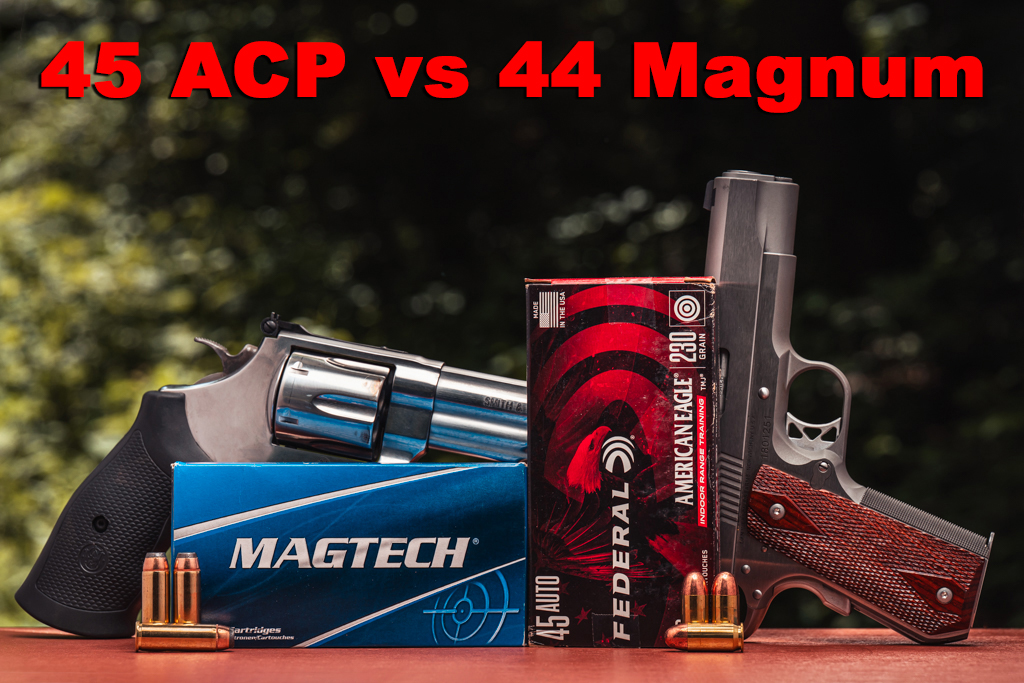
This comparison perfectly illustrates the 45 ACP vs. 44 Magnum question. The 45 ACP, a semi-automatic cartridge, emphasizes accurate rapid fire – although its terminal performance is not anemic by any standard. The 44 Mag, a revolver cartridge, delivers too much recoil for any normal man to put a whole cylinder into a target in a couple of seconds. But one single 44 Mag placed into a threat’s center of mass is all it should take to end the altercation.
We’re going to skip the lengthy histories of these two rounds. You can find that info on a thousand other websites. We’re only interested in how their ballistic performance, stopping power, recoil and price tag compare to one another so you can make a more informed choice about which ammo you should prefer for personal protection.
Cartridge Dimensions
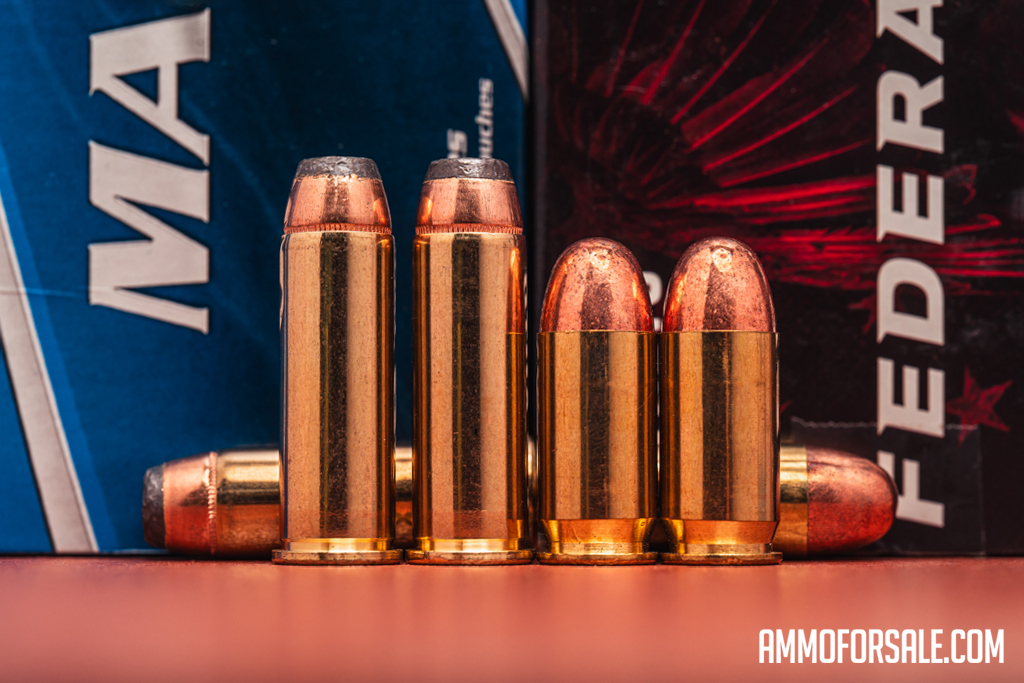
44 Magnum cartridges (left) next to 45 ACP ammunition (right.)
Let’s take a quick look at the physical dimensions of the 45 ACP and 44 Mag before we compare their performance.
| 45 ACP | 44 Mag | |
|---|---|---|
| Parent case | -- | 44 S&W Special |
| Case type | Rimless, straight | Rimmed, straight |
| Bullet diameter | 0.452 in | 0.429 in |
| Neck diameter | 0.473 in | 0.457 in |
| Base diameter | 0.476 in | 0.457 in |
| Rim diameter | 0.480 in | 0.514 in |
| Rim thickness | 0.049 in | 0.060 in |
| Case length | 0.898 in | 1.285 in |
| Overall length | 1.275 in | 1.61 in |
| Case capacity | 26.7 gr H2O | 37.9 gr H2O |
| Maximum pressure | 21,000 psi | 36,000 psi |
A couple key things to point out about these two rounds’ physical aspects. The 44 Mag has a rim so it chambers correctly in a cylinder; the 45 ACP hasn’t got one to ensure smoother feeding in a semi-auto. There are always exceptions to a rule, of course. The semi-auto Desert Eagle is available chambered for 44 Mag, and the S&W Model 625 revolver is chambered for 45 ACP. You’re not stuck racking a slide or spinning a cylinder depending on your ammo choice.
The 44 Mag’s case is a little narrower in diameter than the 45 ACP’s – but also more than 40 percent longer. It accordingly has over 40 percent greater capacity for propellant, the magic black stuff that goes “bang.” But the two rounds’ bullets aren’t all that different in diameter, nor do they differ greatly in weight. A 44 Mag’s standard bullet weighs 240 grains, only 10 grains heavier than the 45 ACP. In effect the 44 Mag is putting a lot more energy behind roughly the same bullet.
Ballistics
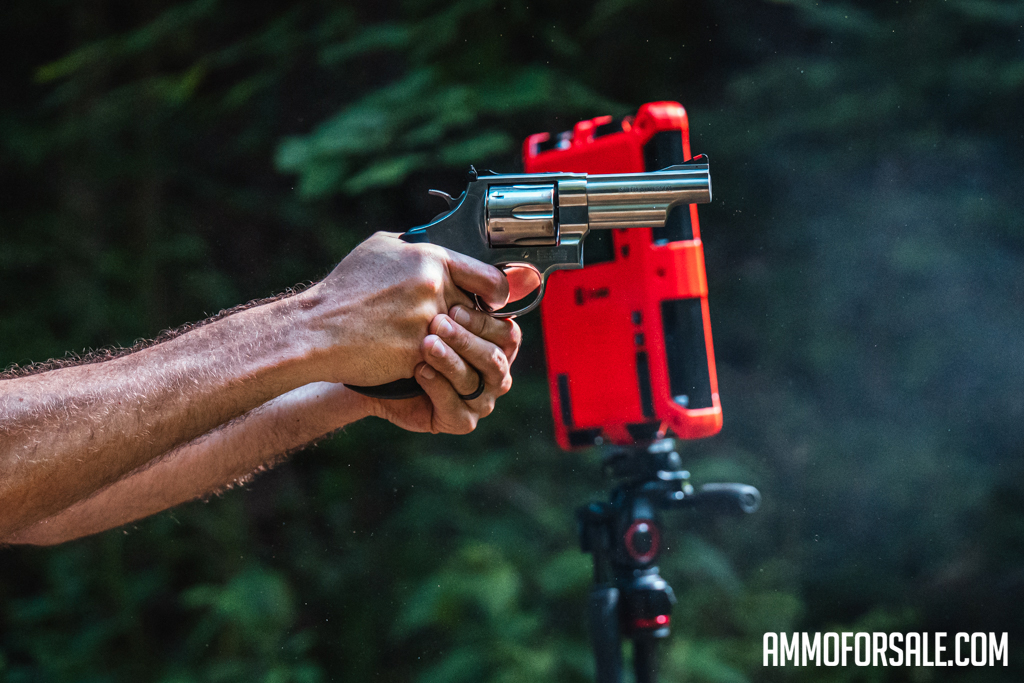
Both the 45 ACP and the 44 Mag offer good accuracy. A reasonably experienced shooter can place 3 to 4 inch wide shot groups with either type of handgun at 50 yards, and you’re not likely to engage a threat at distances farther than that.
But the two rounds do offer different in-flight ballistics. Their bullets and their ballistic coefficients (a measure of ability to overcome air resistance in flight, where a higher number is better) are not radically unalike.
Their muzzle velocities are significantly different, however, which you can see reflected in our data for six comparable cartridges.
| 45 ACP Federal 230gr FMJ | 44 Mag Federal 240gr JHP | |
|---|---|---|
| Muzzle velocity (fps) | 890 | 1230 |
| Velocity @ 25 yds | 872 | 1170 |
| Velocity @ 50 yds | 856 | 1118 |
| Velocity @ 75yds | 840 | 1074 |
| Velocity @ 100 yds | 825 | 1037 |
| 45 ACP Remington HTP 230gr JHP | 44 Mag Remington HTP 240gr SJHP | |
| Muzzle velocity (fps) | 835 | 1180 |
| Velocity @ 25 yds | 817 | 1127 |
| Velocity @ 50 yds | 801 | 1082 |
| Velocity @ 75yds | 785 | 1044 |
| Velocity @ 100 yds | 769 | 1011 |
| 45 ACP Prvi Partizan 185gr SJHP | 44 Mag Prvi Partizan 180gr JHP | |
| Muzzle velocity (fps) | 935 | 1804 |
| Velocity @ 25 yds | 917 | 1707 |
| Velocity @ 50 yds | 899 | 1614 |
| Velocity @ 75yds | 883 | 1526 |
| Velocity @ 100 yds | 867 | 1443 |
The 44 Mag bullet comes out of the barrel a whole lot faster, and it maintains that velocity advantage over the 45 ACP at all ranges. Its greater velocity means the 44 Mag has a flatter trajectory – it simply gives gravity less time to pull its bullet down to earth. That enables the shooter to aim closer to the bullseye instead of above it, thus making it easier to hit more distant targets.
But again, the 45 ACP is not inaccurate by comparison! Its effective range is 200 yards, and Second Lieutenant Owen J. Baggett once used his M1911 to shoot a Japanese fighter pilot in his cockpit – while parachuting.
| 45 ACP Federal 230gr FMJ | 44 Mag Federal 240gr JHP | |
|---|---|---|
| Muzzle energy (ft lbs) | 405 | 806 |
| Energy @ 25 yds | 389 | 729 |
| Energy @ 50 yds | 374 | 666 |
| Energy @ 75 yds | 360 | 615 |
| Energy @ 100 yds | 347 | 573 |
| 45 ACP Remington HTP 230gr JHP | 44 Mag Remington HTP 240gr SJHP | |
| Muzzle energy (ft lbs) | 356 | 742 |
| Energy @ 25 yds | 341 | 677 |
| Energy @ 50 yds | 327 | 624 |
| Energy @ 75 yds | 314 | 581 |
| Energy @ 100 yds | 302 | 544 |
| 45 ACP Prvi Partizan 185gr SJHP | 44 Mag Prvi Partizan 180gr JHP | |
| Muzzle energy (ft lbs) | 359 | 1301 |
| Energy @ 25 yds | 345 | 1164 |
| Energy @ 50 yds | 332 | 1042 |
| Energy @ 75 yds | 320 | 931 |
| Energy @ 100 yds | 309 | 833 |
Stopping Power
We use the term “Stopping power” to describe how efficiently a firearm can neutralize a threat. Several factors contribute to a round’s stopping power including its bullet’s sectional density (which determines how efficiently it can penetrate its target) and terminal ballistics (which include how much energy it can distribute within its target).
We’re going to make things simpler by only comparing the two rounds’ energies as measured in foot-pound force. That’s basically a measure of how hard a bullet hits. And here’s a fact: The 44 Mag hits a lot harder.
The 45 ACP is no weakling. It was designed for self-defense, and at no point up until 100 yards does its bullet carry fewer than 300 ft lbs of force. (As a general rule, 220 to 300 ft lbs of force are advisable for self-defense.) You can find a ton of good 45 ACP ammo options for self-defense.
The 44 Mag’s muzzle energy is more than double the minimum recommended for self-defense, and often approaches triple. Heck, the 44 Mag even makes a fine selection for deer hunting within a range of 50 yards, while no one would advise using the 45 ACP for taking whitetail.
The 44 Mag generally hits its target with twice as much energy as the 45 ACP. That’s like the difference between getting punched by an expert street fighter and getting absolutely pulverized by Mike Tyson in his prime. (As you’d probably guess, 44 Mag can also be a great choice with lots of solid 44 magnum self-defense ammo options.)
Recoil
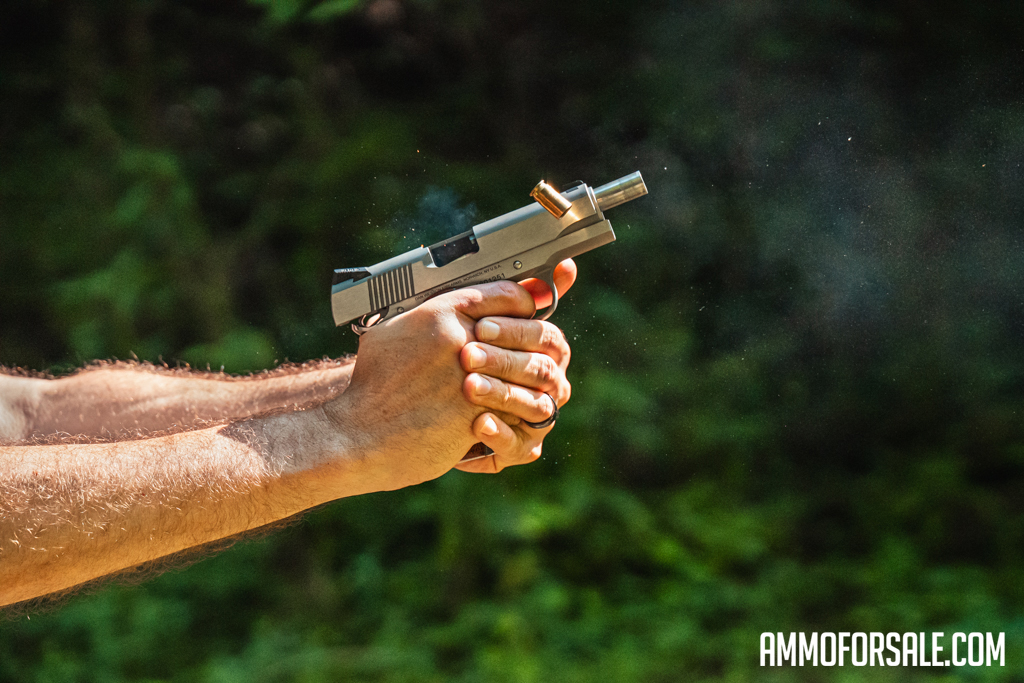
“Recoil” refers to how much kick the shooter experiences when he fires a cartridge. In practice it is impossible to describe just how much recoil a shooter is going to actually experience. That’s subjective, partly because we all have different physiques and nervous systems.
What we can accurately measure is a round’s recoil energy as measured in foot-pound force. To do this we factor bullet weight, muzzle velocity, propellant charge weight and firearm weight. For the sake of simplicity we’re assuming the 45 ACP rounds compared above all have 5 grains of propellant and the 44 Mag rounds have 15 grains. For the sake of comparison we’re firing the 45 ACP in a 39 ounce M1911 and the 44 Mag in a 39 ounce Ruger Vaquero.
Recoil Energy Table
| Recoil Energy (ft lbs) | |
|---|---|
| 45 ACP Federal American Eagle 230gt FMJ | 6.87 |
| 45 ACP Remington HTP 230gt JHP | 6.13 |
| 45 ACP Prvi Partizan 185gr SJHP | 5.1 |
| 44 Mag Federal American Eagle 240gr JHP | 17.83 |
| 44 Mag Remington HTP 240gr SJHP | 16.69 |
| 44 Mag Prvi Partizan 180gr JHP | 20.79 |
The results demonstrate an interesting rule of physics. The 45 ACP and 44 Mag rounds all have similar bullet weights, within 10 grains of one another. It is only their muzzle velocities that differ substantially. Still, this difference is enough for the 44 Mag to generate up to four times as much recoil energy as the 45 ACP!
Think back to our fighter analogy. The 45 ACP’s recoil energy is low enough that a modestly experienced shooter can empty out a magazine fast and accurately. A single shot won’t jerk the pistol’s muzzle very far upward, thus making it easier to restore aim for follow-up shots.
The 44 Mag’s recoil energy is so powerful that many shooters find it uncomfortable, although most shooters can tolerate 18 to 20 ft lbs of recoil without complaining too much. Yet that is still a lot of recoil and resultant muzzle flip, making it a lot harder to put several rounds of 44 Mag into a threat very quickly.
In short, the 45 ACP’s lower recoil facilitates rapid fire. The 44 Mag’s substantial kick places a huge incentive on the shooter to make their first shot count.
Price & Availability
In normal market conditions in the year 2026 a box of fifty 45 ACP ammo costs about $8, whereas a box of 44 Magnum ammunition costs about $25. This is partly because the 44 Mag contains more metal. One round of 45 ACP weighs about 0.737 ounces, which is somewhat lighter than the 44 Mag which weighs 0.820 ounces.
Ammo manufacturers can also charge less for 45 ACP because there’s much greater demand for it. The M1911 was the standard-issue sidearm for the U.S. Armed forces from 1911 until 1985. For countless Americans the 45 ACP is the pistol cartridge they spent the most time training with, and that will have a lasting ripple on its popularity for self-defense for decades.
The 44 Magnum hit the market over 40 years later and has never been standard-issue. It is still reasonably popular thanks in no small part to movies like Dirty Harry and Taxi Driver, which posed two timeless questions: “Do I feel lucky?” and “You talkin’ to me?” Ultimately you’ll have no difficulty finding firearms chambered for either cartridge as well as their ammunition.
Takeaway
The 45 ACP vs. 44 Magnum debate boils down to your preferred self-defense strategy. If you want to dump a mag at a threat quickly and accurately – and rest assured that a single one of your shots is powerful to neutralize said threat – the 45 ACP will serve you splendidly. If you would rather carry a revolver, which is a more reliable handgun design owing to its fewer moving parts, and know for absolute certain that a single shot will level a threat for good, the 44 Mag is your man. Just don’t miss.
Leave A Comment