
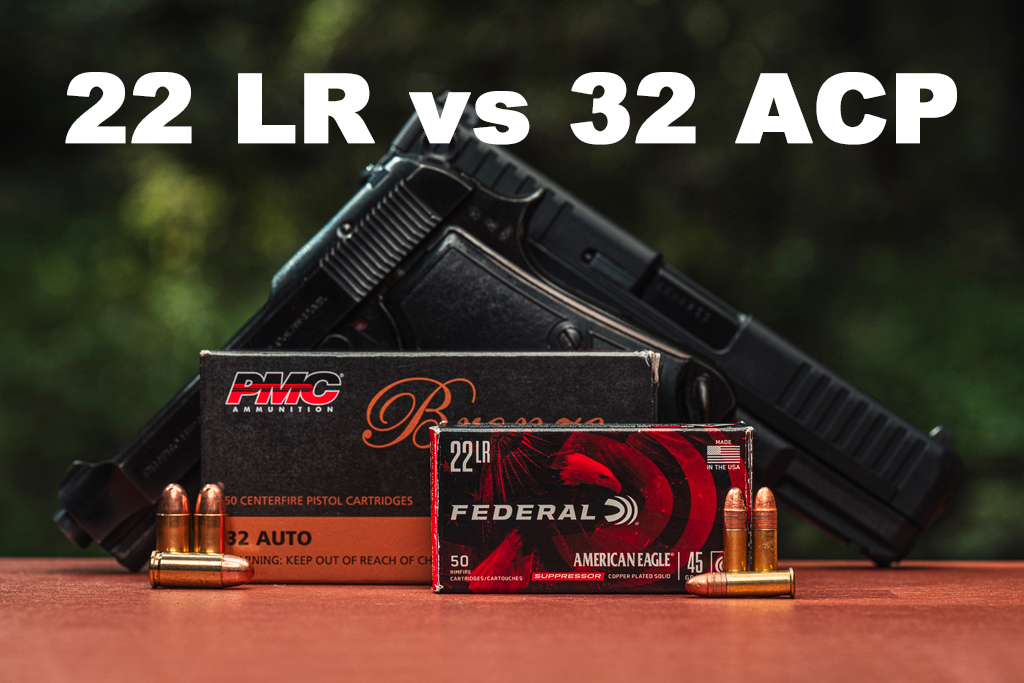
Overwhelming power: It’s a very handy thing to have at your fingertips when someone means to do you immediate bodily harm – but it’s not always practical. Some folks just can’t handle a handgun that kicks like a mule. Others need a firearm they can easily conceal on their person, whether it’s inside their pocket or their pocketbook. Still others already have a very powerful primary sidearm, but desire a smaller backup they can strap to their ankle.
Overwhelming power: The 22 LR and the 32 ACP do not have it. But they are small cartridges, which makes their respective handguns extremely useful for the aforementioned reasons.
So which of these pipsqueak cartridges would you be better off selecting for personal protection? We’re going to compare the two rounds’ ballistic performance, stopping power, recoil energy and more to settle the 22 LR vs. 32 ACP debate once and for all.
Cartridge Dimensions
| 22 LR | 32 ACP | |
|---|---|---|
| Case type | Rimmed, straight | Semi-rimmed, straight |
| Bullet diameter | 0.223 in | 0.3125 in |
| Neck diameter | 0.226 in | 0.3365 in |
| Base diameter | 0.226 in | 0.337 in |
| Rim diameter | 0.278 in | 0.358 in |
| Rim thickness | 0.043 in | 0.045 in |
| Case length | 0.613 in | 0.680 in |
| Overall length | 1.000 in | 0.984 in |
| Maximum pressure | 24,656 psi | 20,500 psi |
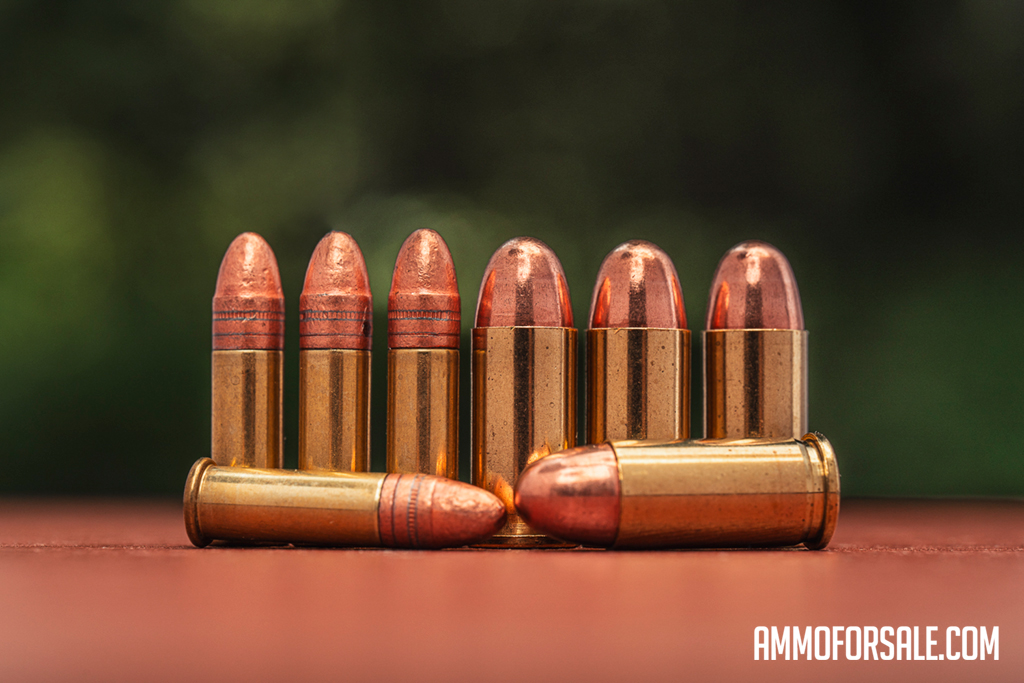
Teensy-weensy. That ingratiating adjective applies to the 22 LR and the 32 ACP alike. The 22 LR has a slightly longer overall length, but the 32 ACP is approximately 40% wider in diameter. This means the 32 ACP is able to pack a 60–73 grain bullet as opposed to the 22 LR’s usual 40 grains. We should expect the 32 ACP’s approximately 75% heavier bullet to deal significantly more damage.
We can also reasonably expect a rimfire round to be weaker than a centerfire one. Due to the nature of a rimfire primer’s design, the 22 LR’s case brass cannot be too thick or it will prevent ignition. Its thin case in turn limits the amount of chamber pressure a rimfire-primed round can generate (too much pressure would crack the brass and render the firearm inoperable).
One more interesting point: the 22 LR is a rimmed round while the 32 ACP is only semi-rimmed. Without getting into too much detail, rimmed cartridges don’t feed and extract as reliably in a semi-automatic firearm. This isn’t to suggest you couldn’t pour thousands of 22 LR rounds through a good semi-auto with zero failures to feed or extract, but the 32 ACP is designed for semi-autos while the 22 LR is not.
32 ACP vs. 22 Long Rifle – Ballistics
| 22 LR - CCI Mini-Mag 36gr CPHP | 32 ACP - Remington UMC 71gr FMJ | 22 LR - Federal 40gr LRN | 32 ACP - Winchester 71gr FMJ | 22 LR - Win. Super Suppressed 45gr CPHP | 32 ACP - Sellier & Bellot 73gr FMJ |
|
|---|---|---|---|---|---|---|
| Muzzle velocity (fps) | 1260 | 905 | 1200 | 905 | 1090 | 1043 |
| Velocity @ 25 yds | 1176 | 879 | 1130 | 879 | 1053 | 1001 |
| Velocity @ 50 yds | 1107 | 855 | 1074 | 856 | 1021 | 965 |
| Velocity @ 75 yds | 1051 | 832 | 1028 | 834 | 992 | 934 |
| Velocity @ 100 yds | 1006 | 811 | 989 | 813 | 967 | 905 |
| G1 ballistic coefficient | 0.129 | 0.133 | 0.138 | 0.137 | 0.188 | 0.135 |
| Drop @ 25 yds | 0 | 0.01 | 0 | 0.01 | 0.01 | 0 |
| Drop @ 50 yds | -1.34 | -2.55 | -1.48 | -2.55 | -1.73 | -1.91 |
| Drop @ 75 yds | -4.47 | -8.09 | -4.84 | -8.07 | -5.55 | -6.16 |
| Drop @ 100 yds | -9.55 | -16.76 | -10.25 | -16.72 | -11.58 | -12.91 |
| Muzzle energy (ft lbs) | 127 | 129 | 128 | 129 | 119 | 176 |
| Energy @ 25 yds | 110 | 122 | 114 | 122 | 111 | 162 |
| Energy @ 50 yds | 98 | 115 | 102 | 116 | 104 | 151 |
| Energy @ 75 yds | 88 | 109 | 94 | 110 | 98 | 141 |
| Energy @ 100 yds | 81 | 104 | 87 | 104 | 93 | 133 |
Disclaimer: Our ballistic data are skewed, because the 22 LR data are taken from a rifle barrel while the 32 ACP data are taken from a pistol barrel. A longer barrel imparts significantly more muzzle velocity to a bullet and as the result better accuracy over longer distances. We can realistically expect a 22 LR pistol to produce a muzzle velocity closer to 990 fps
Neither the 22 LR nor the 32 ACP are long-distance cartridges by any measure. That said, the 22 LR does offer better accuracy in spite of its smaller dimensions.
An exceptional marksman can hit a 150 yard target with a 22 LR rifle; a 22 LR pistol, on the other hand, is generally good for rabbit-sized targets at 50 to 75 yards and human-sized targets at 100 yards. (Please keep in mind that if you disagree with this broad statement, it is only because you’re a skilled shooter – which is a compliment and not an insult.)
32 ACP rifles are relics and don’t beg elaboration. 32 ACP pistols are generally accurate enough to strike a man-sized target at 50 yards, but a subcompact purse pistol has a hard time covering even that much distance.
If you’re wondering whether either of these rounds’ will offer more of the accuracy you would want for reliable personal protection, then you don’t have to worry. It is unlikely that you will have to neutralize a threat that is standing farther than five yards away. If you’re concerned about encountering a threat standing 50 or 100 yards away, then you had better carry a rifle – and also have good justification for perceiving so distant a person as a threat in the first place.
Stopping Power
Many factors determine a cartridge’s stopping power including penetration depth, wound channel diameter, and energy delivery.
A bullet’s ability to penetrate is measured by its sectional density, which is basically a number that reflects how efficiently it can overcome resistance from soft tissue it meets head on. The 32 ACP’s 71 grain bullet has a sectional density of 0.104; the 22 LR’s 40 grain bullet, 0.115. In effect the 22 LR can penetrate deeper – but only if it has enough momentum to let its sectional density shine at its fullest potential.
The 32 ACP’s bullet is nearly 0.1” wider in diameter, so it’s necessarily going to bore a wider, more incapacitating hole into a threat. “But what about terminal expansion?” you might ask. Good question! Neither the 22 LR nor the 32 ACP bullet really gets enough energy to expand when fired out of a typical pistol barrel – regardless of whether it’s a hollow point or JHP.
As for energy delivery, as a general rule you want the bullet to deliver at least 220 to 300 ft lbs of energy on impact. On the best of days, neither the 22 LR nor the 32 ACP will ever deliver that kind of energy. But the 32 ACP does deliver a lot more energy.
Recall that our ballistic data are skewed because the 22 LR data came from a rifle whereas the 32 ACP data came from a pistol. When a 22 LR is fired from a pistol, its muzzle energy drops much lower to around 60–70 ft lbs. In effect the 32 ACP is actually about twice as powerful than the 22 LR close up, which makes its stopping power far more debilitating. (But still incomparable to that of the 9mm, which consistently boasts a muzzle energy in excess of 300 ft lbs).
Recoil
Recoil is better known as kick – it describes how violently a firearm will jerk backward and upward when fired. Less recoil makes a cartridge more comfortable to fire, but it also makes it easier to keep your muzzle trained on the target. Basically, less recoil facilitates faster yet still accurate follow-up shots.
How much recoil you’ll actually perceive is impossible to calculate, because that is purely subjective. We cannot measure your nervous system’s ability to sense discomfort. But we can objectively calculate recoil energy by taking into account four variables: propellant weight, bullet weight, firearm weight and muzzle velocity.
Let’s compare the recoil energy of the six cartridges detailed above. For simplicity’s sake let’s assume all 32 ACP loads have 2.3 grains of powder and we are firing a Beretta 3032 Tomcat Inox (14.46 oz with empty mag); 22 LR rounds have 2 grains of powder and we are firing a Glock 44 (14.64 oz with empty mag).
| Recoil Energy (ft lbs) | |
|---|---|
| CCI Mini-Mag 22 LR 36gr CPHP | 1.06 |
| Federal 22 LR 40gr LRN | 1.17 |
| Winchester 22 LR 45gr CPHP | 1.21 |
| Remington UMC 32 ACP 71gr FMJ | 2.01 |
| Winchester 32 ACP 71gr FMJ | 2.01 |
| Sellier & Bellot 32 ACP 73gr FMJ | 2.7 |
It’s plain to see that the 32 ACP produces about double the recoil energy of the 22 LR. But here’s the thing: 2 ft lbs of recoil energy is still absolutely negligible. As such neither cartridge offers a real advantage in the form of lower recoil – even the smallest adult can comfortably fire either one rapidly and still see good accuracy.
Price & Availability
The 32 ACP is not an obscure cartridge. You will find it at brick and mortar stores, and we typically have it in stock.
But it pales in comparison to the availability of 22 long rifle ammo. This is the world’s most popular cartridge, full stop. Unless you’re shopping during the midst of an ammo famine, you will find a wide selection of 22 LR ammo at every store you go to.
Firearms are the same story. You won’t have to hunt far and wide to find at least a few different semi-auto 32 ACP handguns for sale, but 22 LR semi-auto handguns and revolvers are omnipresent. What’s more, you’ll be able to find every imaginable style of 22 LR rifle: bolt-action, lever-action, semi-automatic, and even AR.
Finally, 22 LR ammo is much, MUCH cheaper than 32 ACP ammo. In short, if price and availability are your main criteria for preferring one cartridge over the other, the 22 LR is by far your better bet.
Takeaway
Looking for a self-defense cartridge? A 32 ACP pistol’s relative lack of power may suit it better as a backup weapon than as your primary sidearm, but even so it delivers about twice as much energy to its target at close range than a 22 LR pistol is capable of. All else aside, this simple fact makes the 32 ACP vastly preferable for personal protection.
The 22 LR is not useless for self-defense (so long as you have good aim). Its tiny dimensions may make the 22 LR perfect for super-compact handguns and derringers, but where it really shines is as a cost-effective plinking, target shooting and varmint hunting cartridge. In summary, unless you’re already extremely familiar with the 22 LR’s performance and want to rely on that experience for self-defense, we’d strongly advise going with the 32 ACP over 22 LR for personal protection.
Leave A Comment