
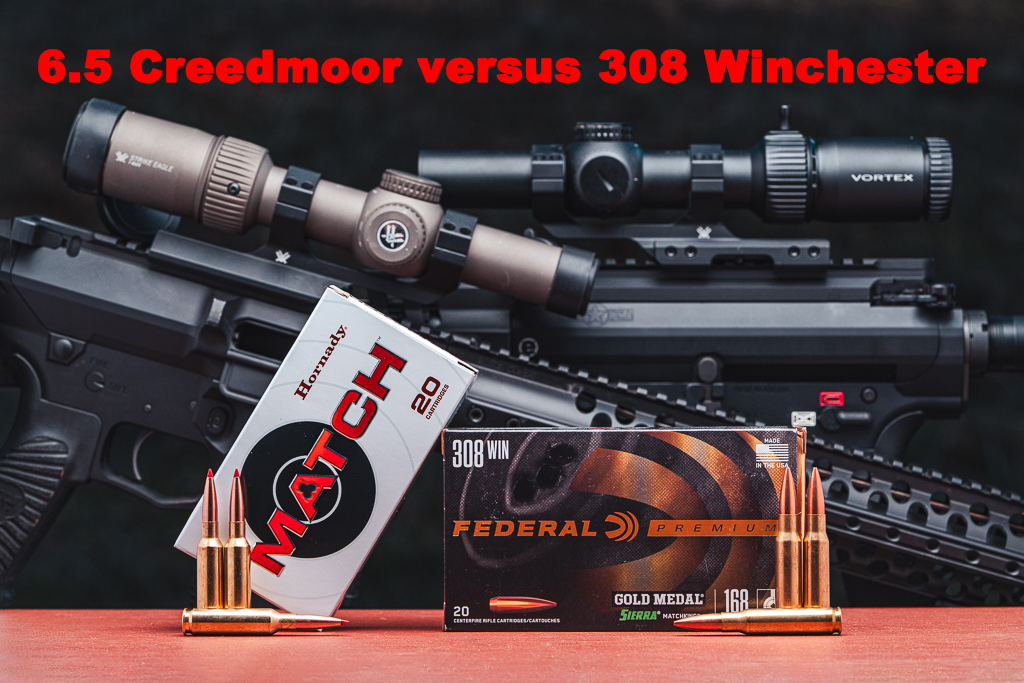
War and peace – either one is a good reason to design a new rifle cartridge. Winchester devised the 308 Win in the early ‘50s after tinkering around with the T65 series experimental cartridge designed on the behalf of the U.S. Military. Because the 308 is virtually identical to our Armed Forces’ current 7.62×51, pretty much any veteran who has held an M14 or M60 is already familiar with its performance. (That right there is the primary reason for the 308’s astounding popularity, especially during deer season.)
The 6.5 Creedmoor, on the other hand, was conceived and developed completely for peaceful purposes. Hornady partnered up with Creedmoor Sports in 2007 to create a superior long-distance shooting round and nothing more. But because the 6.5 CM is so accurate at long range, it’s little wonder why so many deer hunters favor it.
So here’s the question: Is the 6.5 CM “better” than the 308 Win? Or are both rounds different enough that they deserve their own separate places in our hearts? (As well as in deer’s hearts, albeit in a more literal sense?) Let’s compare these two centerfire rifle cartridges’ ballistic performance, stopping power, recoil energy and more and see where one outclasses the other.
Cartridge Dimensions
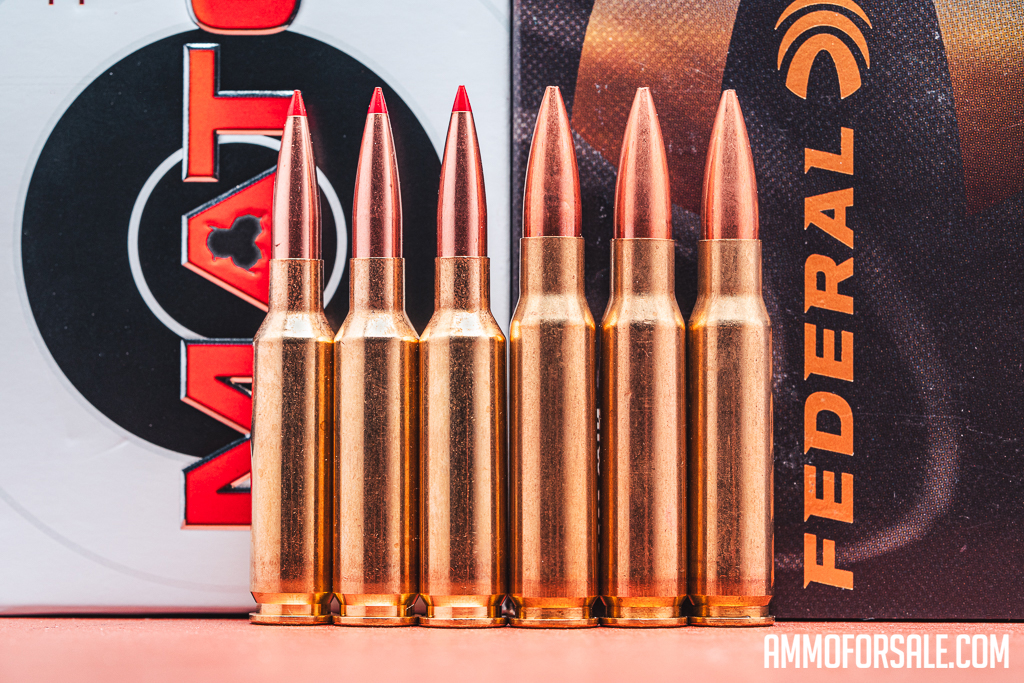
These are remarkably similar cartridges, all things considered. They have virtually identical lengths, extremely similar capacity for propellant, and maximum chamber pressures within 1,000 psi of one another. Neither round is so large that it’s incompatible with the AR platform, so you can enjoy the great Eugene Stoner’s engineering no matter which you’re firing.
| 308 Win | 6.5 Creedmoor | |
|---|---|---|
| Parent case | 300 Savage | 30 TC |
| Case type | Rimless, bottleneck | Rimless, bottleneck |
| Bullet diameter | 0.308 in | 0.2644 in |
| Neck diameter | 0.3433 in | 0.295 in |
| Shoulder diameter | 0.4539 in | 0.462 in |
| Base diameter | 0.4709 in | 0.4703 in |
| Rim diameter | 0.4728 in | 0.473 in |
| Case length | 2.015 in | 1.920 in |
| Overall length | 2.800 in | 2.825 in |
| Case capacity | 56 gr H2O | 52.5 gr H2O |
| Maximum pressure | 60,191 psi | 62,000 psi |
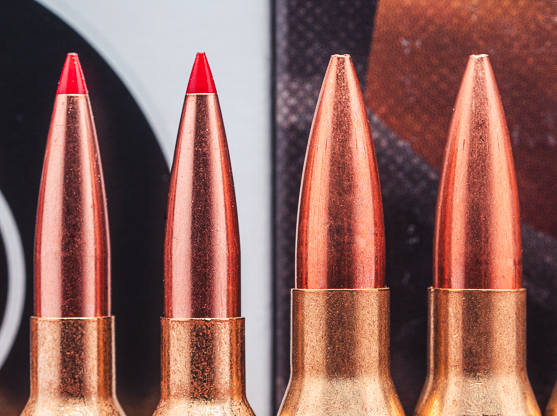
The key difference to appreciate is the rounds’ bullets. 308 Winchester ammo has a wider .30 caliber bullet which usually weighs 150, 168 or 175 grains. The 6.5 CM’s bullet is much smaller in diameter at .2644”, and often weighs 120, 140 or 143 grains. That means if we notice any difference in these rounds’ ballistic performance, it’s probably going to be attributable to the 6.5 CM’s narrower and lighter projectile.
Ballistic Performance
6.5 Creedmoor vs .308 Velocity
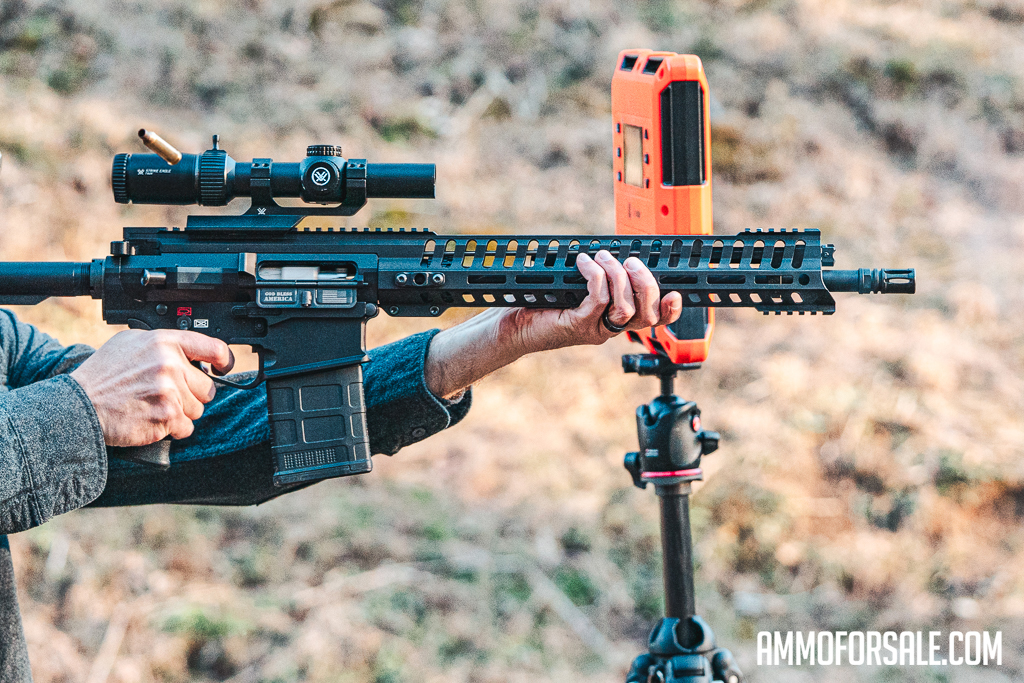
A couple caveats about our data. First, we’re assuming the sight height is 1.5”; second, these data aren’t definitive. Comparing rounds with different bullet weights is never a precise exercise, and variables like atmospheric conditions and barrel length are going to significantly affect a cartridge’s actual ballistic performance.
Both of these rounds are relatively fast moving calibers. It’s not unusual to have speeds in the vicinity of 3,000+ feet per second of bullet velocity at the muzzle.
| 308 - Remington Core-Lokt 150gr PSP | 6.5 CDMR - Remington Core-Lokt 140gr PSP | 308 - Federal Gold Medal 168gr HPBT | 6.5 CDMR - Federal Gold Medal 140gr HPBT | 308 - Hornady Precision Hunter 178gr ELD-X | 6.5 CDMR - Hornady Precision Hunter 143gr ELD-X | |
|---|---|---|---|---|---|---|
| Muzzle velocity (fps) | 2820 | 3100 | 2650 | 3000 | 2600 | 3050 |
| Velocity @ 100 yds | 2537 | 2868 | 2463 | 2825 | 2440 | 2895 |
| Velocity @ 200 yds | 2271 | 2648 | 2283 | 2656 | 2286 | 2747 |
| Velocity @ 300 yds | 2022 | 2438 | 2111 | 2494 | 2138 | 2603 |
| Velocity @ 400 yds | 1790 | 2238 | 1947 | 2338 | 1995 | 2463 |
| Velocity @ 500 yds | 1578 | 2047 | 1791 | 2187 | 1858 | 2328 |
| Velocity @ 600 yds | 1390 | 1867 | 1644 | 2041 | 1727 | 2197 |
| Velocity @ 700 yds | 1232 | 1697 | 1508 | 1902 | 1604 | 2070 |
| Velocity @ 800 yds | 1111 | 1540 | 1384 | 1769 | 1489 | 1947 |
| Velocity @ 900 yds | 1026 | 1398 | 1273 | 1643 | 1383 | 1829 |
| Velocity @ 1000 yds | 963 | 1273 | 1180 | 1525 | 1287 | 1716 |
Trajectory
All of that aside, it’s easy to identify the 6.5 CM as the flatter-shooting cartridge. Even when we’re zeroed in at a relatively close range of 300 yards, it’s easy to see how much flatter the 6.5 CM bullet beelines to its target. To be sure, a flat trajectory isn’t synonymous with accuracy. An experienced shooter will take trajectory into account without a second’s thought. But in general, the flatter-shooting round makes it easier to hit a target.
| 308 - Remington Core-Lokt 150gr PSP | 6.5 CDMR - Remington Core-Lokt 140gr PSP | 308 - Federal Gold Medal 168gr HPBT | 6.5 CDMR - Federal Gold Medal 140gr HPBT | 308 - Hornady Precision Hunter 178gr ELD-X | 6.5 CDMR - Hornady Precision Hunter 143gr ELD-X | |
|---|---|---|---|---|---|---|
| G1 ballistic coefficient | 0.319 | 0.417 | 0.469 | 0.543 | 0.545 | 0.625 |
| G7 ballistic coefficient | 0.162 | 0.211 | 0.237 | 0.273 | 0.275 | 0.315 |
| Elevation @ 100 yds | 4.89 | 3.49 | 5.08 | 3.56 | 5.13 | 3.31 |
| Elevation @ 200 yds | 5.84 | 4.23 | 5.9 | 4.25 | 5.9 | 3.97 |
| Elevation @ 300 yds | 0.02 | 0 | 0.03 | 0 | 0 | 0 |
| Elevation @ 400 yds | -14.36 | -10.09 | -13.65 | -9.85 | -13.52 | -9.1 |
| Elevation @ 500 yds | -39.66 | -27.15 | -36.53 | -26.07 | -35.8 | -23.94 |
| Elevation @ 600 yds | -78.99 | -52.53 | -70.28 | -49.58 | -68.17 | -45.2 |
| Elevation @ 700 yds | -136.4 | -87.92 | -116.92 | -81.44 | -112.22 | -73.69 |
| Elevation @ 800 yds | -216.75 | -135.42 | -178.88 | -122.93 | -169.8 | -110.3 |
| Elevation @ 900 yds | -325.41 | -197.63 | -259.03 | -175.56 | -243.09 | -156.09 |
| Elevation @ 1000 yds | -466.88 | -277.67 | -360.63 | -241.08 | -334.58 | -212.29 |
Why is Creedmoor A Flatter Shooting Round?
The 6.5 CM’s flatter trajectory is largely attributable to its lighter bullet, which accordingly achieves a higher muzzle velocity. It is also the product of the 6.5 CM’s higher ballistic coefficient. This is essentially a measure of a bullet’s ability to overcome air resistance in flight, where a higher number is better. To that end, we may also reasonably assume the 6.5 CM’s bullet is going to benefit from greater resistance to wind deflection, relatively higher downrange velocities, and greater energy delivery on impact.
How Do Effective Ranges Compare?
According to the US Army Technical Manual 9-1005-306-10, the maximum effective range for the 7.62×51 M24 Sniper Weapon System is 875 yards. Since the 308 is so similar to the 7.62×51, we can also safely assume that 875 yards is the “maximum distance at which [the 308] may be expected to be accurate and achieve the desired effect.” (Bearing in mind that the “desired effect” in the Army’s case is neutralizing an enemy combatant.)
The 6.5 CM’s effective range is much farther: 1,000 to 1,200 yards, according to target shooters who aren’t concerned with neutralizing threats or killing deer. In summary, if you’re only interested in long-distance shooting, the 6.5 CM is the preferable cartridge.
Stopping Power
| 308 - Remington Core-Lokt 150gr PSP | 6.5 CDMR - Remington Core-Lokt 140gr PSP | 308 - Federal Gold Medal 168gr HPBT | 6.5 CDMR - Federal Gold Medal 140gr HPBT | 308 - Hornady Precision Hunter 178gr ELD-X | 6.5 CDMR - Hornady Precision Hunter 143gr ELD-X | |
|---|---|---|---|---|---|---|
| Muzzle energy (ft lbs) | 2649 | 2988 | 2620 | 2798 | 2672 | 2954 |
| Energy @ 100 yds | 2144 | 2557 | 2263 | 2481 | 2354 | 2663 |
| Energy @ 200 yds | 1719 | 2180 | 1945 | 2194 | 2066 | 2396 |
| Energy @ 300 yds | 1362 | 1848 | 1663 | 1934 | 1806 | 2151 |
| Energy @ 400 yds | 1067 | 1557 | 1414 | 1699 | 1573 | 1927 |
| Energy @ 500 yds | 829 | 1303 | 1197 | 1487 | 1364 | 1721 |
| Energy @ 600 yds | 643 | 1083 | 1009 | 1296 | 1179 | 1532 |
| Energy @ 700 yds | 505 | 895 | 849 | 1125 | 1017 | 1360 |
| Energy @ 800 yds | 411 | 738 | 714 | 973 | 876 | 1204 |
| Energy @ 900 yds | 351 | 607 | 605 | 839 | 756 | 1063 |
| Energy @ 1000 yds | 309 | 504 | 519 | 723 | 655 | 936 |
Let us proceed with the assumption that you’re not wondering whether the 308 or 6.5 CM is better for home defense. Either of these rounds will absolutely devastate a threat within several hundred yards – unless your living room is half a mile wide, neither cartridge could offer an advantage for home defense.
Use for Hunters
But what about deer and elk hunting? In general, you want at least 1,000 ft lbs of energy on impact when you’re hunting whitetail, or 1,500 ft lbs of energy when you’re doing an elk. If we average the data of the three 308 cartridges compared above, we see that the 308 retains at least 1,000 ft lbs of energy at 580 yards, and 1,500 ft lbs of energy at 352 yards. When we do the same for 6.5 CM, we see that it retains at least 1,000 ft lbs of energy at 790 yards, and 1,500 ft lbs of energy at 509 yards.
We’re only speaking in very general terms here. The 308 rounds have a wider range of bullet weights, which does affect how hard any of them can hit their targets, and impact energy is not the sole deciding factor when it comes to determining stopping power. With that in mind, we can still safely say the 6.5 CM hits its target harder at any practical range.
Recoil
| Recoil Energy (ft lbs) | |
|---|---|
| 308 Win Remington Core-Lokt 150gr PSP | 9.77 |
| 308 Win Federal Gold Medal 168gr HPBT | 10.48 |
| 308 Win Hornady Precision Hunter 178gr ELD-X | 11.06 |
| 6.5 Creedmoor Remington Core-Lokt 140 gr PSP | 8.41 |
| 6.5 Creedmoor Federal Gold Medal 140 gr HPBT | 8.41 |
| 6.5 Creedmoor Hornady Precision Hunter 143 gr ELD-X | 8.65 |
Lower recoil doesn’t just make target practice more comfortable. It also makes it easier to fire successive shots more quickly. That’s because less recoil will cause accordingly less muzzle flip, so you won’t have to take as much time restoring your aim on the target.
To calculate a cartridge’s recoil, all you need is the firearm weight, powder weight, bullet weight and muzzle velocity. For the sake of comparing recoil energy, let’s assume all six cartridges compared above are loaded with 40 grains of powder and we’re firing 12.6 pound rifles.
Under these conditions, the 308 has an average recoil energy of 10.44 ft lbs; the 6.5 CM, 8.49 ft lbs. Neither round’s recoil is so powerful that a high-volume target shooter is likely to become uncomfortable – indeed, you may not even notice a difference, because the amount of recoil energy you’ll actually perceive is subjective. But if you solely want the lower recoil round, the 6.5 CM would serve you better.
Price & Availability
Finally: the 308’s time to shine. After the 223 Rem (and nearly identical 5.56×45), the 308 (and nearly identical 7.62×51) is America’s favorite centerfire rifle cartridge. Its popularity means you’re going to have a much easier time finding 308 ammo as well as rifles chambered for it. 308 is slightly cheaper than 6.5 CM, too, because ammo companies are able to lower their production costs by manufacturing a whole lot more of it at once.
This isn’t to suggest that 6.5 Creedmoor ammo and rifles are hard to come by (unless you’re in the midst of an ammo drought). You’re just going to wind up paying more for fewer options if you commit to the newer and less popular cartridge.
Takeaway
Better accuracy. More stopping power. Lower recoil. The 6.5 CM’s superiority seems like a no-brainer. Right?
Wrong. Fact is, most shooters are always going to prefer a certain type of ammunition when it’s easier to find and rifles chambered for it are more available as well.
In spite of all the 6.5 CM’s advantages, we’d still recommend the good old 308 to anyone who’s considering purchasing their first hunting rifle. At the end of the day, the 308’s performance is more than adequate for most self-defense and hunting applications – even if there are better alternatives – and the 308’s widespread availability makes target practice and hunting a lot more accessible in the long run.
Leave A Comment